MDS in UK After BDS in India: Routes, Costs and GDC Rules for 2026

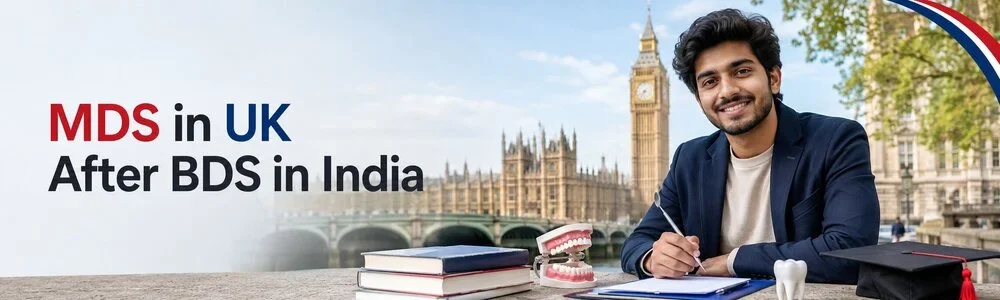
MDS in UK After BDS in India

There is no MDS in the UK. MDS in UK after BDS in India means choosing between two separate things: a taught master’s such as an MClinDent, and General Dental Council registration through the GDC Overseas Registration Exam Part 2, where Part 2 alone now costs GBP 6,967. Only registration lets you treat patients. If NEET MDS did not go your way, that is exactly why this search gets typed, and no UK programme asks for a NEET MDS score. The two tracks carry very different price tags and very different endings, and a few clinical programmes quietly shut out an unregistered Indian dentist before the application window even opens. Here is what each route costs and where it leaves you.

Written by
Senior Counsellor (British Council Certified) -UK & Ireland
Shiva Sai Bejawada is a British Council Certified overseas-education counsellor at AOEC India who guides Indian students through UK and Ireland university selection, admissions, and student visa documentation.
6 Years, 96% visa approval rate
Reviewed by
Managing Director
Mr. Kongara Sridhar, Director of AOEC India, has over 12 years of experience in overseas education consulting, admissions, and student visa guidance.
Over 12 years Experience

Key Takeaways

  • The UK awards no MDS. UCL Eastman Dental Institute awards MSc, PG Cert, MClinDent and DDent instead.
  • A UK master’s gives you no right to practise. Only GDC registration does that.
  • The Overseas Registration Exam costs GBP 7,567 in fees end to end (about INR 9.69 lakh).
  • ORE Part 1 pass rates were 73% and 75% across the two 2025 sittings, not the single-digit figure that circulates online.
  • You get four attempts at each ORE part, and Part 2 must be passed within five years of your first Part 1.
  • A three-year MClinDent at UCL costs GBP 210,900 (about INR 2.70 crore) and still leaves you unregistered.
  • Some programmes, including UCL Implant Dentistry MSc, require GDC registration before you can enrol at all.

Two routes exist, and they do different jobs. A taught master's such as an MClinDent deepens one speciality; General Dental Council registration, won through the Overseas Registration Exam (ORE) or the Licence in Dental Surgery (LDS), is what puts your name on the register. The British Dental Association guidance on ORE, LDS and eligibility to practise names those two exams as the only recognised registration routes.

That distinction decides everything downstream, so settle it before you shortlist a single university. If your plan is to return to India with a sharper speciality and a stronger CV, take the master’s and skip the exams entirely. If your plan is to work chairside in Britain, the master’s is optional and the ORE is not. Pick the exam first and the degree second, because that order determines which programmes will even accept your application.

RouteCostAttemptsWhat it leaves you
Overseas Registration Exam (ORE)GBP 7,567 in exam fees (INR 9.69 lakh)4 per partGDC registration and the right to treat patients
Licence in Dental Surgery (LDS)GBP 900 for Part 1, GBP 1,025 from Oct 2026 (INR 1.15 to 1.31 lakh)4 at Part 1GDC registration and the right to treat patients
Taught master’s (MSc, MClinDent, DClinDent)GBP 31,450 to GBP 210,900 total (INR 40.3 lakh to 2.70 crore)Not applicableA UK qualification, and no practice rights

The naming confusion is worth clearing up once. For 2026/27 entry, UCL Eastman Dental Institute awards MSc, PG Cert, MClinDent and DDent, with no MDS among them. Indian students still search for PG dentistry in the UK after BDS using the Indian label, which is why the term persists on consultancy pages that never correct it. The wider study in UK picture applies here too, but dentistry is one of the few fields where the degree and the licence come apart completely.

UK dentistry master’s programmes you can apply to with an Indian BDS

Fees for a UK dentistry master's fall into three bands, and which band you land in depends on whether the programme is clinical. For 2026 entry, Cardiff's Clinical Dentistry (Prosthodontics) MClinDent charges GBP 54,700 a year, identical for home and overseas students. The cheapest realistic entry points are the non-clinical MScs at the top of this table.

ProgrammeAwardFee per yearTotalGDC registration needed to enrol?
Queen Mary, Oral BiologyMSc1 yearGBP 31,450 (INR 40.3 lakh)No
Leeds, Dental Public HealthMSc12 monthsGBP 32,750 (INR 41.9 lakh)No
Cardiff, Clinical Dentistry (Prosthodontics)MClinDentGBP 54,700 (INR 70.1 lakh)GBP 164,100 (INR 2.10 crore)No, but MJDF, MFDS or FDS required
Queen Mary, ProsthodonticsDClinDentGBP 66,450 (INR 85.1 lakh)GBP 199,350 (INR 2.55 crore)No
UCL, PeriodontologyMClinDentGBP 70,300 (INR 90.0 lakh)GBP 210,900 (INR 2.70 crore)No
Queen Mary, Endodontic PracticeMScGBP 22,200 (INR 28.4 lakh)GBP 66,600 (INR 85.3 lakh)Yes, plus UK residential status
UCL, Implant DentistryMScNot publishedNot publishedYes, full and current registration

Read the last column before you read the fee column. For 2026/27 entry, UCL Implant Dentistry MSc requires full and current registration with the UK General Dental Council, and Queen Mary’s Endodontic Practice MSc is open to overseas applicants only if they already hold full GDC registration and UK residential status. An Indian BDS holder who has not sat the ORE cannot enrol on either, whatever the fee page says. Queen Mary’s Prosthodontics DClinDent carries no such condition, which is why two programmes at the same university can sit on opposite sides of this line.

Clinical programmes ask for chairside history rather than marks alone. UCL Periodontology MClinDent requires an approved dental qualification and a minimum of two years clinical experience after qualifying, and Cardiff wants evidence of registration as a dental practitioner plus a pass in the MJDF, MFDS or FDS qualifications of the Royal College of Surgeons. If you finished BDS last year, the honest reading is that the clinical master’s are closed to you for now and the non-clinical MScs are not.

Here is the part that deserves to sting. Three years of UCL Periodontology MClinDent costs GBP 210,900 and does not register you to treat a single NHS or private patient in Britain. UCL does guarantee that postgraduate taught fees will not rise during the programme, and overseas offer holders pay a deposit of 10% of the first year, so the number is at least predictable. Predictable is not the same as good value, and against the wider cost of studying in UK this is close to the top of what any Indian family will be asked to fund. Our top universities in UK for masters breakdown covers the non-dental comparison.

How Indian dentists get GDC registered: ORE, LDS and the Lancashire route

GBP 7,567 is what the Overseas Registration Exam costs end to end: GBP 115 to apply, GBP 485 for Part 1 and GBP 6,967 for Part 2. On 6 May 2026, the General Dental Council confirmed that ORE Part 2 rose from GBP 4,235 to GBP 6,967 while Part 1 fell from GBP 584 to GBP 485. That 65% jump on the expensive half changed the maths for every Indian dentist planning this route.

Whether your BDS makes you eligible at all

Your BDS is the starting point, not the qualification. As at 2026, the GDC requires at least 1,600 hours of clinical experience treating patients in the dental chair, plus a UK ENIC Statement of Comparability, which is the official document that maps your Indian degree onto its UK equivalent. The GDC aims to assess complete applications within 60 working days, so build that into any timeline you are drawing up.

The English requirement the GDC actually sets

The bar is higher than most universities set. Under current GDC guidance, you need IELTS Academic, overall average 7, with a minimum 6.5 in reading, writing, listening and speaking, and the Test Report Form must usually be no more than two years old when you submit.

Two escape hatches get quoted at Indian dentists and neither one holds up. The GDC’s guidance names IELTS Academic and no other test, so the OET score you may have been told is acceptable does not appear in it. And the “my BDS was taught in English” exemption counts only if the degree is no more than two years old, at least 75% of clinical interaction was in English, and a structured English language reference is supplied. India is also not on the UK list of majority English speaking countries, and official-language status alone exempts nobody. Plan on sitting IELTS.

ORE Part 1 and Part 2: what each costs and tests

Part 1 is two computer-based papers of three hours each, and both must be passed before you can progress. Part 2 is the clinical half: four components covering an operative test of three procedures over three hours, an OSCE, diagnostic and treatment planning, and medical emergencies. Fail the medical emergencies component alone and the retake costs GBP 686, which is the one part-failure worth insuring against by over-preparing.

The two clocks that catch people out

You get four attempts at each part, and Part 2 must be passed within five years of your first attempt at Part 1. Once you have passed, there is no time limit on applying for registration, so the pressure sits entirely inside that five-year window. Sit Part 1 as early as you can afford to is the wrong instinct here: the clock starts on your first Part 1 attempt, so an early sitting you are not ready for burns both an attempt and a year of the window.

The pass rates are also worth seeing before you believe a forum. In 2025, ORE Part 1 average pass rates were 73% in April and 75% in August, and Part 2 ranged from 66% to 76%. The exam is demanding but it is not the single-digit lottery it gets described as. The GDC also states plainly that it does not quality assure, endorse or recommend any ORE preparation course, so treat every coaching claim of an official link as marketing.

1,600

Clinical hours required before you can apply GDC, 2026

73-75%

ORE Part 1 pass rate across the 2025 sittings GDC, 2025

GBP 698

Annual Retention Fee once registered (INR 89,407) GDC, 2026

The LDS and the Lancashire alternatives

The LDS is the second door to the same register, run by the Royal College of Surgeons of England rather than the GDC. In 2026, LDS Part 1 costs GBP 900 for the June sitting and GBP 1,025 from October 2026, with a maximum of four attempts overall and both papers to be passed in the same sitting. It is a three-part exam, and passing it allows GDC registration exactly as the ORE does.

The third route gets almost no coverage. The University of Lancashire, formerly the University of Central Lancashire, runs a BDS International Route (BDSi) that admits overseas qualified dentists partway through its own BDS, and it needs a minimum of 600 hours of clinical postgraduate dentistry experience within the past 5 years. That is well under the ORE’s 1,600 hours, which makes it the realistic option for a recent graduate who cannot yet meet the exam’s threshold. It costs GBP 44,500 a year for international students in 2026/27 across two fee years, asks for IELTS 7.0 or above in each of the four components plus a UK entry assessment, and the GDC granted it full programme approval in August 2024. The name change is also why searches for it keep failing: the old UCLan course pages no longer resolve.

From our counselling desk: the dental files we handle split almost evenly between students who want to practise in Britain and students who want a UK speciality to take home, and they need opposite advice. The ones who lose money are those who buy the degree first and discover the licence afterwards, usually in year two of a clinical master's they could not legally have completed as an unregistered dentist. We now ask one question before any shortlist gets built: do you intend to hold a GDC number? Everything else follows from that answer.

Where each route leaves you: practice rights, visas and pay

Picture two Indian dentists finishing the same UK master’s in the same summer. One sat ORE Part 1 during their first year and clears Part 2 that autumn. The other did not sit it at all. Their next three years look nothing alike, and the difference has very little to do with the degree either of them just paid for.

Both can stay on for a while. As at August 2026, the Graduate visa lasts 2 years if you apply on or before 31 December 2026, 18 months if you apply on or after 1 January 2027, or 3 years with a doctoral qualification. It costs GBP 937 plus a healthcare surcharge of GBP 1,035 for each year in the UK. Only the registered dentist can spend that time treating patients; the unregistered one can work, but not chairside, which is a slow and expensive way to discover the rule. Getting to that point runs through the ordinary student route first, so the CAS full form in UK explainer and our cover letter for UK student visa guide both apply before any of this starts. Dentistry also sits well inside the range covered in highest paying jobs in the UK for Indians.

If you already hold an Indian MDS, do one thing before spending anything on the ORE. Since October 2025, the College of General Dentistry recognises the Indian MDS awarded by DCI-recognised institutions, making holders eligible by default for Associate Fellowship. It is recognition of your existing qualification rather than a licence to practise, and it costs a fraction of an exam attempt.

One older workaround is gone. Since 8 March 2023, the route for overseas dentists to register in Dental Care Professional categories such as dental hygienist or dental therapist closed to new applications, so the sideways entry that used to buy time no longer exists. The Royal College of Surgeons is equally blunt that success in the ORE or LDS does not mean you will automatically secure a job in UK dentistry. Registration opens the door; it does not walk you through it.

Get in Touch

Frequently Asked Questions

No. UK dental schools award MSc, MClinDent, DClinDent, DDent and PG Cert, and none of them is called an MDS. Indian students use the term because it is the qualification name back home, but no UK university issues one under that title.

No. UK universities assess your BDS marks, your clinical experience after qualifying, and your English test score. NEET MDS plays no part in a UK application, which is exactly why this route attracts Indian dentists who missed a seat at home.

Not on the degree alone. Practising requires registration with the General Dental Council, and that comes only from passing the Overseas Registration Exam or the Licence in Dental Surgery. A master’s can strengthen your clinical skills, but it confers no practice rights whatsoever.

GBP 7,567 in fees, or roughly INR 9.69 lakh: GBP 115 to apply, GBP 485 for Part 1 and GBP 6,967 for Part 2. That excludes travel, preparation courses and the GBP 686 medical emergencies retake if you need it.

Four attempts at Part 1 and four at Part 2. The tighter constraint is time: Part 2 must be passed within five years of your first Part 1 attempt. After passing, there is no deadline on applying for GDC registration itself.

Sources

Official sources first, then reputable third-party. All figures are 2026 or 2026/27 entry.

Everything you need to study abroad, in one place.

Explore articles and guides that help you prepare with confidence, covering scholarship applications, financial planning, and tips for adapting to a new culture. We have built comprehensive resources to get you ready for your educational adventure.

Study in UK After 12th

Study in UK after 12th

Study in UK After 12th for Indian Students: Complete 2026-27 Guide Finished Class 12 and the UK is on your