Requirements to Study in Ireland for Indian Students

Requirements to Study in Ireland for Indian Students

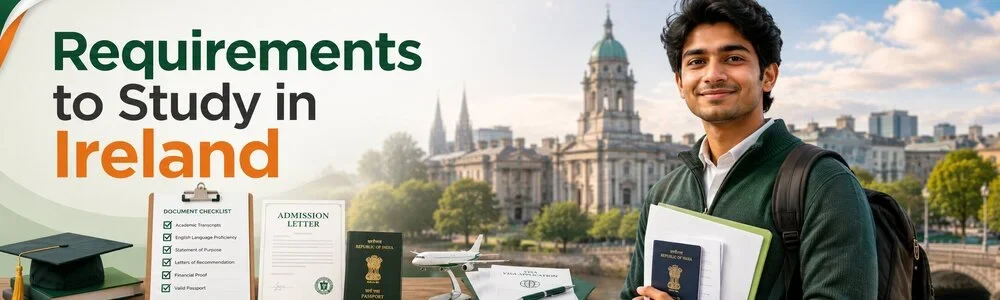
The requirements to study in Ireland for Indian students cover four gates: a Class 12 or Bachelor's academic floor, English language proof (IELTS or MOI), a D Study Visa file, and post-arrival immigration registration. In 2026, the Immigration Service Delivery (formerly INIS), Information on Student Finances rule fixes the visa-stage proof at EUR 10,000 (approx. INR 11.15 lakh) of immediate-access funds per academic year. In our counselling workflow, finance is the first file we stress-test.


If you and your family are weighing Trinity, UCD, UCC or a Technological University for the 2026-27 intake, this article cuts the standard 15-item checklist into four profile bundles. Ireland’s rules diverge by entry point: after Class 12, after Bachelor’s, the MOI route, or the working-professional route. The Playbook below maps each bundle to the paperwork, English proof, and Immigration Service Delivery evidence visa officers check first. One clarification up front: the visa-stage English floor is lower than most university requirements; meeting the Immigration Service Delivery minimum does not guarantee university admission, and vice versa.

FX disclosure: All INR conversions use the live Google-published rate captured on 2026-05-22: EUR 1 ≈ INR 111.54. Rates fluctuate intraday; figures are indicative.

Key Takeaways

  • EUR 10,000 (INR 11.15 lakh) immediate-access funds per academic year is the D Study Visa proof rule, on top of tuition.
  • Any course over 90 days must be on the ILEP or the TrustEd Ireland Providers list before tuition is paid.
  • University working standard is IELTS 6.5 (UCC 6.0 some UG; TCD 7.0 some PG). Visa floor: IELTS 5.0 / iBT 61 / PTE 30.
  • Many Irish institutions may accept an MOI waiver for selected programmes; acceptance must be confirmed on the current programme page or offer conditions. The visa English floor still applies.
  • Private medical insurance (EUR 25,000 accident + EUR 25,000 disease) is a visa-stage gate, not a post-arrival formality.
  • Stamp 2: 20 hr/week term, 40 hr/week holidays; Stamp 1G: 12 months (Level 8) or 24 months (Level 9/10).
RequirementIndian-student action
Accepted full-time courseCheck ILEP or TrustEd Ireland eligibility before paying tuition
Academic proofClass 12 (UG) or Bachelor’s transcripts (PG) – 60-70% / 55-65% typical
English proofIELTS / PTE / TOEFL / Duolingo / MOI letter (university floor); IELTS 5.0 / iBT 61 / PTE 30 visa floor
FundsEUR 10,000 (approx. INR 11.15 lakh) immediate-access per academic year
Tuition paymentFull fee if under EUR 6,000; at least EUR 6,000 paid if above
Visa processAVATS application + VFS document + biometrics + Embassy review
InsuranceEUR 25,000 accident + EUR 25,000 disease private medical insurance evidence
ArrivalGarda registration for IRP / Stamp 2 within first month

What’s the 90-second profile check before you tackle Ireland’s requirement list?

Profile triage is the first step. Indian applicants to Ireland fall into four bundles: After-12th undergraduate (UG), After-Bachelor's postgraduate (PG), Working professional applying for an executive masters or PhD, and MOI-route applicants skipping IELTS. Each bundle has a separate document stack and visa risk profile, which is why a single 15-item checklist misleads most students.

Before booking an IELTS slot or notarising an affidavit of support, decide which bundle the family is working with. Picking the wrong bundle wastes weeks on documents the university or visa officer will never read. Most families we counsel discover the bundle in that first conversation.

The After-12th UG bundle is heaviest on transcripts and English proof. The After-Bachelor’s PG bundle is heaviest on Statement of Purpose (SOP) and academic references. Working professionals need experience letters and a clear study-purpose narrative. MOI-route applicants need a board-issued medium-of-instruction certificate plus a backup English evidence file.

After Class 12 UG
 
Class 12 transcript (60-70%), IELTS 6.5 or PTE 63, SOP, two academic references, passport, fee receipts to the college (EUR 6,000+ before visa).
After Bachelor’s PG
 
Bachelor’s transcript (55-65%+), IELTS 6.5 to 7.0, SOP, two academic or work references, CV, GMAT/GRE for select MBAs.
Working Professional
 
Bachelor’s, IELTS 6.5+, 2-3 experience letters, employer reference, CV, SOP explaining the study-now choice, and self/sponsor finance proof.
MOI-Route Applicant
 
Board-issued MOI certificate (Class 10, 12, and Bachelor’s where applicable), English-medium transcripts, plus visa-stage English evidence.

After Class 12, what does an Irish undergraduate offer demand from an Indian student?

The After-Class-12 bundle is built around two academic gates and one English gate. For the 2026-27 intake, most Irish universities require a Class 12 minimum of 60-70%, according to aggregated Tier C admissions data we cross-checked with university brochures. CBSE, ICSE, and state-board students all qualify, but TCD, UCD and DCU sit at the upper end of the band for popular Business and Computer Science offers.

With strong Class 12 English marks and a clean record, the UG offer process moves quickly. The university wants four things: predicted or final Class 12 marksan English language proofa short SOP, and passport-grade ID. References are lighter at UG than at PG, so the document folder stays slim.

For English, plan for IELTS 6.5 overall as the working standard. Most Irish universities require IELTS 6.5 for both UG and PG; UCC accepts 6.0 for some UG programmes; TCD pushes some PG courses to 7.0. PTE Academic 63 and TOEFL iBT 90 are accepted at the same Common European Framework of Reference (CEFR) B2/C1 level. The certificate is typically treated as valid for two years from course start, so a 2024 IELTS for a 2026 intake will usually pass.

UniversityClass 12 minimum (typical)UG IELTS minimum
Trinity College Dublin (TCD)70%+6.5
University College Dublin (UCD)65-70%6.5
University College Cork (UCC)60-65%6.0
University of Galway60-65%6.5
Dublin City University (DCU)65-70%6.5
University of Limerick (UL)60-65%6.5
Maynooth University60-65%6.5

The cutoffs above are typical ranges; individual programmes vary by a few percentage points. Cross-check the official English language pages at Trinity College DublinUCD Registry, and University College Cork for current programme-level bands. For an Ireland UG study-in-Ireland intake calendar, our hub page covers the seven main universities and the Technological University network.

After Bachelor’s, what does an Irish master’s offer demand from an Indian student?

The After-Bachelor's bundle moves the academic bar up and shifts weight onto the SOP. For the 2026-27 intake, most Irish universities require a bachelor's degree with an overall score of 55-65%, according to aggregated admissions data, with TCD and UCD often asking for 65% or a first class for high-demand masters. GMAT or GRE is optional at most Irish universities, mandatory only at select MBA programmes.

For PG, the stack tightens around three artefacts: a strong Statement of Purpose (SOP), two Letters of Recommendation (LORs), and a sharp CV. Indian engineering and commerce graduates dominate the Irish PG cohort, so admissions committees see thousands of similar transcripts. The SOP is where you separate yourself; the CV anchors work experience or research projects.

UniversityBachelor’s % typicalPG IELTS minimumGMAT/GRE
Trinity College Dublin (TCD)65%+ / First class6.5-7.0Only for MBA / select Finance
University College Dublin (UCD)60-65%6.5Only for MBA / select Finance
University College Cork (UCC)55-65%6.5Not required for most programmes
Dublin City University (DCU)55-60%6.5Not required for most programmes
University of Limerick (UL)55-60%6.5Not required for most programmes

A common family question: does a 6.5 IELTS overall with 5.5 in writing pass? Programmes set their own band minimums (often 6.0 in writing for PG). The Immigration Service Delivery, English language requirements for study visas page sets a lower visa-purpose minimum: for higher-ed degree applicants the visa floor sits around IELTS 5.0 / TOEFL iBT 61 / PTE Academic 30. So 6.5 overall with 5.5 writing usually clears the visa floor but can fail at university stage if the programme wants a higher writing sub-score. If borderline, retake before submitting.

Does the MOI waiver let you skip IELTS for Ireland?

Partially. The Medium of Instruction (MOI) waiver lets many Indian students skip IELTS at the university admissions stage if Class 10, Class 12, and the Bachelor's degree (where applicable) were taught and examined entirely in English. The waiver removes the test fee and the test-prep weeks, but Immigration Service Delivery still sets a visa-purpose English floor around IELTS 5.0 / TOEFL iBT 61 / PTE Academic 30 for higher-ed applicants.

Acceptance varies by institution and by programme. Many Irish universities will consider an MOI waiver for selected courses when CBSE, ICSE/ISC, or major state-board students (Maharashtra HSC, Tamil Nadu HSE, Karnataka PUC, AP/Telangana Intermediate, West Bengal HS, Kerala HSE, Gujarat HSEB) supply a board-issued or school-principal-signed MOI letter naming English as the medium for Class 10 and 12. PG applicants also need an MOI letter from the Bachelor’s university. Confirm acceptance on the current programme page or in your offer conditions before relying on the waiver.

The waiver saves real money: the IELTS fee (four-figure rupees in India) plus 6 to 12 weeks of test prep and result waiting. But it is conditional, and not every university accepts it for every programme. Apply the four-point validity test before banking on it:

  • Has your university listed MOI acceptance in writing for your specific programme this year?
  • Does your Class 10 and Class 12 certificate explicitly state “English medium”? Marksheets alone often don’t.
  • For PG, does your Bachelor’s MOI letter come from the Registrar or HOD, not just the principal?
  • Have you mapped your visa-stage English plan: even if MOI is accepted at university, the Embassy can still request additional English evidence during document review.

Where MOI fails: Some TCD and UCD postgraduate programmes (especially Education, Law, Journalism, Healthcare) decline the MOI waiver and ask for a formal IELTS or PTE score. Treat MOI as a probability, not a guarantee, until your offer letter confirms it. If your programme rejects MOI, book an IELTS test 8-10 weeks before submission.

What does the D Study Visa financial proof gate actually require, and how do visa officers read your bank statements?

The D Study Visa is Ireland's long-stay visa for courses over three months. In 2026, the Immigration Service Delivery rule requires immediate access to at least EUR 10,000 (approx. INR 11.15 lakh) per academic year on top of tuition. Visa officers read the bank statement as a story of stability, not a single snapshot.

Before starting the visa file, confirm ILEP / TrustEd Ireland eligibility. Per the Immigration Service Delivery, Interim List of Eligible Programmes (ILEP), any course over 90 days must appear on the ILEP or the new TrustEd Ireland Providers list. No listing means no Stamp 2. Because the ILEP is being replaced by TrustEd Ireland (administered by Quality and Qualifications Ireland, QQI) and is now closed to new provider applications, check both lists before paying a deposit.

Parents reading this: the figure that matters for loan eligibility and the visa file is EUR 10,000 (approx. INR 11.15 lakh) per academic year, in an immediately accessible account, on top of tuition paid. HDFC Credila, Avanse, SBI, Bank of Baroda and ICICI structure their Ireland loan packages around this figure plus first-year tuition, so aligning the sanction letter with Immigration Service Delivery’s wording removes most visa-stage anxiety in one step.

Across the Indian student files we triage, finance is the first stack we stress-test, because Immigration Service Delivery requires documentary proof that the EUR 10,000 is genuinely accessible and traceable to a named source. For year-on-year living costs, see the cost of studying in Ireland guide. The numbers aren’t unreasonable for most middle-class families, but how the money sits, how it arrived, and where it traces to matter as much as the total. The visa officer’s mental model is risk-of-overstay, not academic eligibility. A clean paper trail beats a high balance every time.

EUR 10,000

Immediate-access funds (per academic year) ISD, 2026

EUR 6,000

Minimum tuition paid before visa application ISD, 2026

EUR 833/mo

Proof rule for 6-8 month courses (from 30 June 2025) ISD, 2025

EUR 60-100

Visa application fee (single / multi-journey) DFA Ireland, 2026

Two thresholds shape the visa file. If the course fee is under EUR 6,000 (approx. INR 6.69 lakh), pay the full tuition before applying. If more, pay at least EUR 6,000 before applying. The college fee receipt is the second-most-scrutinised document after the bank statement.

From 30 June 2025, Immigration Service Delivery introduced a separate proof rule for 6 to 8 month courses: EUR 833 per month, or EUR 6,665 (approx. INR 7.43 lakh) for an 8-month stay. This matters most for compressed one-year masters and English-language pathway programmes. Stipend funding plans should cross-check the Ireland scholarships overview for awards that offset this baseline.

Private medical insurance is a visa-stage requirement, not a post-arrival formality. Per the Immigration Service Delivery, Private Medical Insurance page, cover must be at least EUR 25,000 for accidents and EUR 25,000 for disease. If your acceptance letter confirms the college’s group policy, that satisfies Year 1; otherwise upload your own policy. After Year 1, you must hold an Irish-provider policy. Keep the policy or college insurance proof handy for both visa filing and later registration: the same evidence is reviewed at both stages, and missing it at registration can delay the IRP card.

How visa officers read your statements: any large or irregular lodgements must be explained. Bank-statement red flags in 2026 Indian files:

  • Lump-sum credit within 30 days of filing with no source document: reads as a borrowed top-up.
  • Multiple small deposits from third-party UPIs without a sponsor declaration.
  • Sponsor account low for 5 months, full in month 6: reads as orchestration, not saving.
  • Loan disbursal without the sanction letter from HDFC Credila, Avanse, SBI or whichever lender named Ireland tuition as purpose.
  • Property-sale proceeds without the sale deed: the EUR 10,000 traces to “unknown source.”

You also need to pass the visa English floor (around IELTS 5.0 / TOEFL iBT 61 / PTE Academic 30 for higher-ed applicants), alongside an MOI letter if skipping the test at university stage. The Department of Foreign Affairs Ireland recommends applying 12 weeks before travel; clean files clear in 4 to 8 weeks at the Embassy of Ireland in New Delhi.

Which 5 requirements actually decide your Ireland offer (and which 15 do listicles pad with)?

From the Indian student files we triage at Ardent, weak applications usually fail on one of five requirements. The other fifteen items are hygiene checks, not gates. Here is how we rank outcomes:

  1. Academic minimums (Class 12% or Bachelor’s%) – you either meet the cutoff or you don’t.
  2. English proof (IELTS / PTE / valid MOI) – missing or below band = auto-reject at admissions or visa.
  3. EUR 10,000 immediate-access financial proof – one of the most common visa-risk points we stress-test.
  4. EUR 6,000+ tuition paid before visa – no receipt, no Embassy review of the file.
  5. A clean Statement of Purpose tied to the chosen programme – thin or generic SOPs sink offers at TCD, UCD and DCU.

Compare those five against the fifteen items every listicle gives equal weight. Most are hygiene checks: real documents the file needs, but rarely the standalone reject reason. When the family plans the next 90 days, work the top five first and batch the other fifteen in parallel.

Padded requirementWhy it’s a hygiene check, not a gate
Passport copyMandatory; rarely the reject reason.
Two LORsQuality matters; rarely a reject reason.
Updated CVImportant for PG; secondary at UG.
GMAT/GREMandatory only for select MBA / Finance.
Work experience letterBoosts professional masters; not for fresh grads.
Travel insuranceBundled with health cover; rarely checked alone.
Notarised academic affidavitUseful; not mandatory at most universities.
Police clearance certificateAsked only with criminal-record disclosure.
Birth certificatePassport covers identity proof.
Two passport-size photosSubmission formality.
Address proofUsed for verification, not admissions.
School leaving certificateSubsumed by Class 12 transcripts.
Course brochure printoutAdviser comfort; not a requirement.
Translated marksheets (if non-English)CBSE/ICSE/state boards already English.
Extra reference lettersTwo strong LORs beat four generic ones.

None of these fifteen should be skipped. But if the prep clock is short, sequence the five gate-requirements first; the other fifteen assemble in parallel during the offer-to-visa window. Note: private medical insurance has moved out of this hygiene-check table because it is a visa-stage gate, covered in the financial proof section above.

What happens after admission: Garda registration, Stamp 2, and the 24-month Stamp 1G clock?

After you land in Ireland and start your course, three immigration objects govern your stay: Garda National Immigration Bureau (GNIB) registration, the Stamp 2 student permission, and the post-study Stamp 1G. In 2026, the Immigration Service Delivery, Third Level Graduate Programme grants Stamp 1G permission for up to 24 months depending on your level of study, making Ireland one of the more student-friendly post-study work systems in Europe.

Stamp 2 is your in-course permission. Per Citizens Information, non-EEA students on Stamp 2 can work 20 hours per week in term-time and 40 hours per week during holiday periods (June to September and December 15 to January 15). The hours are tightly enforced; payroll records are cross-checked at stamp renewal. For loan-EMI math, term-time hours at the Irish minimum wage typically cover rent and groceries, not the loan repayment.

Stamp 1G is your post-study work permission. The Third Level Graduate Programme, summarised by the Irish Council for International Students, Third Level Graduate Programme, grants 12 months of full-time work rights for Level 8 (honours degree) graduates and 24 months for Level 9 (master’s) and Level 10 (PhD) graduates, with no employer sponsorship, no salary threshold, and unrestricted 40-hour workweeks. That 24-month window makes the Irish loan ROI math work for most families.

StampStageWork allowanceDuration
Stamp 2During course20 hr/week in term, 40 hr/week in holidaysLength of course (renewed yearly)
Stamp 1GPost-study workFull-time, any employer, no sponsorship12 months (Level 8) or 24 months (Level 9 / 10)
Stamp 4After Critical Skills Employment Permit (CSEP) or 5 years on Stamp 1Full work + family reunification1-5 years, renewable

Two procedural traps catch students each year. First, the Stamp 1G application window: submit within 6 months of final results or lose the automatic 12-month entitlement. Second, the EUR 300 (approx. INR 33,462) registration fee is paid upfront, and Burgh Quay appointment slots run a 3-4 week backlog in autumn. Book the slot as soon as results are out. See our Ireland post-study work visa guide for the full pathway.

First-hand: 3 requirement traps we see in 2026 Indian-student files

From visa briefings we delivered this year, three traps repeatedly cost Indian students offers or visa approvals. All three are fixable if spotted 6-8 weeks before submission.

  1. The “fresh deposit” red flag. Parents funding the visa from a property sale or FD break-up often transfer the full EUR 10,000 equivalent into one account two weeks before filing. The visa officer reads it as orchestrated, not earned, and a missing sale deed or FD maturity certificate is the most common clarification trigger. Fix: spread the consolidation over 90 days. If a lump sum is unavoidable, attach the source document (FD maturity certificate, property sale deed, HDFC Credila or SBI loan sanction letter) on the same file.
  2. The MOI assumption trap. Families assume an English-medium school certificate is enough. The waiver actually needs a board-issued or school-issued MOI certificate that names “English” as the language of instruction, not just an English-medium marksheet. Fix: request the certificate from your registrar 6-8 weeks early; many schools issue it only once a year. Our IELTS preparation guide for Ireland covers the backup route.
  3. The SOP that doesn’t match the programme. Generic “Ireland is a tech hub” SOPs sink files at TCD and UCD. Fix: name two modules from the programme handbook, one faculty member whose research aligns with you, and one career outcome tied to your Bachelor’s. Specificity beats polish, and parents reviewing the draft can spot generic lines quickly.

None of these traps is exotic. They show up because families assemble requirements bottom-up instead of stress-testing the file the way an Embassy reviewer or admissions reader will. The five-vs-fifteen ranking above forces that top-down review.

Get in Touch

Frequently Asked Questions

Most Irish universities expect Class 12 marks in the 60-70% range for UG offers, so a flat 50% closes the door at the big seven. Some private colleges and pathway providers consider 50-55% scores with strong English proof and a coherent SOP, but offer chances at TCD, UCD, UCC, DCU, Galway, UL and Maynooth shrink sharply.

Not always. Many Irish institutions may accept an MOI waiver for selected programmes when CBSE, ICSE, or major state-board students supply an English-medium certificate, but acceptance must be confirmed on the current programme page or offer conditions. Immigration Service Delivery sets a lower visa-purpose floor (around IELTS 5.0 / TOEFL iBT 61 / PTE Academic 30 for higher-ed applicants); the programme requirement is commonly IELTS 6.0-6.5+.

For most Indian applicants the AVATS application plus VFS document and biometric submission goes to the Embassy of Ireland in New Delhi. The Embassy advises 4-8 weeks of processing from the date documents reach it, excluding VFS appointment and transit time. Clean files with verifiable EUR 10,000 access usually clear inside 4-6 weeks.

Yes, with conditions. Immigration Service Delivery accepts a sponsor account if you include a notarised sponsorship affidavit, relationship proof, the sponsor’s 6-month statement showing EUR 10,000 access, and income or ITR evidence. A statement that jumps from a low balance to a high balance two weeks before applying triggers a clarification request.

Stamp 1G alone does not bring dependants. Spouses and children must apply for their own visa or join via a separate dependant route once you transition to a Stamp 4 work permit or Critical Skills Employment Permit. During the 24-month Stamp 1G window you can work full-time, but family reunification waits until permission upgrades.

Ardent Overseas has operated from Hyderabad and Tirupati since 2014, advising 2,500+ Indian students on Ireland, UK and EU admissions, with placement support across the seven main Irish universities. Our editorial process is documented on the Ireland admissions requirements hub.

Everything you need to study abroad, in one place.

Explore articles and guides that help you prepare with confidence, covering scholarship applications, financial planning, and tips for adapting to a new culture. We have built comprehensive resources to get you ready for your educational adventure.