Application Process to Study in Singapore
How to Apply to Study in Singapore: 2026 Step-by-Step Guide for Indian Students Quick answer: To study in Singapore, apply
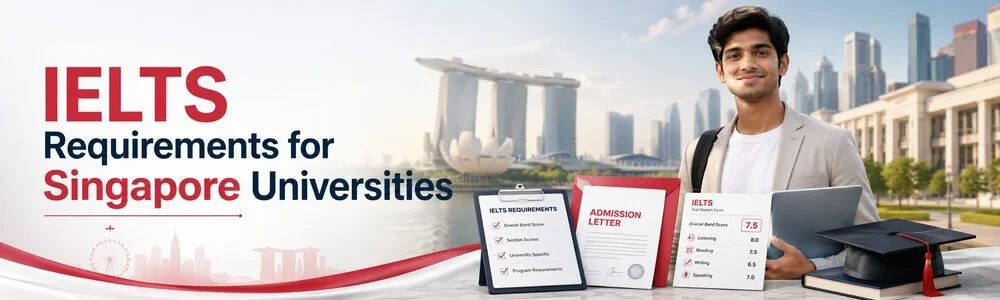


This guide covers the English-language requirements for university admission in Singapore. It does not cover any English requirement for work passes, permanent residence or the Student's Pass itself, which is set separately.
Singapore's six autonomous universities (AUs) publish IELTS Academic bands from 6.0 to 7.5 for 2026 entry. Singapore Management University's Law course sits at the top with 7.5 overall, while the Singapore University of Technology and Design (SUTD) publishes no fixed minimum band. Which band you need depends on the university, the course and whether English was your medium of instruction.
How we verified this: each band was checked against the university's official admissions page, cross-checked against IELTS score validity (two years) and the component sub-band minimums, and the medium-of-instruction waiver rule was confirmed per university. Verified on 06 July 2026.
From our counselling desk: the most common avoidable rejection we see is not a low overall band - it is a missed component minimum (the least you may score in one section). A student scores 7.0 overall but 6.0 in writing, and SMU declines the file, because the 6.5 writing floor is a separate hurdle. Read every sub-band, not just the average.
For 2026 postgraduate coursework, NUS requirements start from IELTS 6.0 (for example, Arts and Social Sciences), with some faculties and programmes set at 6.5 to 7.0 (NUS graduate coursework admission requirements). The IELTS requirements for postgraduate courses in Singapore vary by faculty and programme, so a master's applicant checks the specific department page.
From January 2026, NTU updated its accepted-test list, taking TOEFL iBT, PTE Academic, C1 Advanced, the SAT and the ACT in place of IELTS (NTU international qualifications). Every Singapore autonomous university accepts more than one proof of English proficiency, so IELTS is the default route, not the only one.
From our counselling desk - a real decision: take a CBSE English-medium applicant choosing between NTU and SMU Law. At NTU, the English-medium background means a test score "will not enhance your chances", so IELTS is optional. For SMU Law, the same student faces a high 7.5 with all sections in one sitting - here IELTS is not just needed, it must be strong across every component. Same student, opposite English-test decision.
In 2026, the Academic IELTS test fee in India is INR 19,000, the same for IELTS on Computer and IELTS on Paper (IDP IELTS India, IELTS Test Fee in India). Academic IELTS is the university version of the test, and the fee is charged natively in rupees, so no currency conversion applies.
Check acceptance before you book a One Skill Retake. IELTS One Skill Retake may help only where the university and programme accept it. NUS does not accept IELTS One Skill Retake. SMU requires all test components to be taken in one sitting and does not accept score combinations from different sittings. For NUS or SMU, plan for a full IELTS retake unless admissions confirms another route in writing. OSR lets you retake any one section within 60 days of the full test, but IELTS advises checking with each receiving university first (IELTS One Skill Retake).
Everything you need to study abroad, in one place.
Explore articles and guides that help you prepare with confidence, covering scholarship applications, financial planning, and tips for adapting to a new culture. We have built comprehensive resources to get you ready for your educational adventure.
Application Process to Study in Singapore
How to Apply to Study in Singapore: 2026 Step-by-Step Guide for Indian Students Quick answer: To study in Singapore, apply
Requirements to Study in Singapore for Indian Students
Requirements to Study in Singapore for Indian Students: 2026 Guide If you and your family are weighing a move to
Singapore Student Visa for Indian Students
Singapore Student Visa for Indian Students: Step by Step (2026) The Singapore student visa for Indian students is the Student’s