Requirements to Study in Singapore for Indian Students
Requirements to Study in Singapore for Indian Students: 2026 Guide If you and your family are weighing a move to
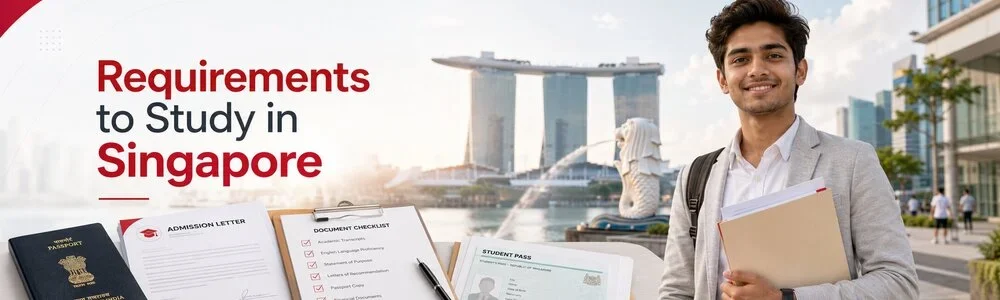


The requirements to study in Singapore for Indian students separate into two layers: university admission requirements and immigration requirements. A foreigner accepted as a full-time matriculated or registered student applies for a Student's Pass online through SOLAR (ICA, Becoming a Student's Pass Holder - Institute of Higher Learning, 2026), making full-time admission the trigger for every immigration step.
Undergraduate academic eligibility is set per university against Class 12 results. The National University of Singapore requires a good pass in five subjects including English for Indian Standard 12 applicants, with standardised tests not required (NUS, Indian Standard 12 (Central and ISC Boards), 2026), confirming that board marks, not entrance exams, anchor the decision.
Master's admission in Singapore rests on a strong undergraduate degree. NUS Graduate School states that an applicant must generally have at least a good Bachelor's degree, equivalent to a good Honours degree of NUS, in the appropriate discipline (NUS Graduate School, Graduate Admissions FAQ, 2026), so your bachelor's class and relevance carry the application.
English-test scores apply conditionally, not universally, and the band varies by university. For tests taken before 21 January 2026, Singapore Management University accepts IELTS 7.0 (reading 7.0, writing 6.5), TOEFL iBT 93, PTE Academic 66, or C1 Advanced 185 (SMU, International and Other Qualifications, 2026), so each institution publishes its own threshold.
Read the score table the right way: these bands apply to applicants who must submit an English test. Some universities waive it when English was your medium of instruction; others, like SMU, still require one accepted standardised test (which can be the SAT or ACT instead of IELTS) for international qualifications. Confirm your university's own rule before you treat any number here as a blanket requirement.
Indian students can study in Singapore without IELTS when English was their medium of instruction. As of 2026, Nanyang Technological University states that if English is your medium of study, taking any English proficiency test will not enhance your chances of admission (NTU, India Standard 12, 2026), so an English-medium school record can substitute for the test.
Three routes admit Indian students, and EduTrust decides whether the private route is even open. As of 2026, ICA confirms that only EduTrust-certified Private Education Institutions, registered with SkillsFuture Singapore, can offer placements to foreign students (ICA, Becoming a Student's Pass Holder - Private Education Institution, 2026), making certification a hard immigration gate.
Singapore prescribes no universal proof-of-funds figure for a student visa. Funding must cover tuition plus living costs, and for the AY2026 cohort, NTU's non-subsidised international tuition runs SGD 36,350 to 40,600 per year (NTU, Tuition Fees - Accepted Programme Offer in 2026, 2026), so funds should realistically span at least one academic year.
The Student's Pass is the immigration pass for full-time study, applied for through ICA's Student's Pass On-Line Application and Registration system. SOLAR was introduced to let foreign students apply for the pass online (ICA, New SOLAR System to Facilitate Foreigners to Study in Singapore, 2003), so the core application is processed digitally from the start.
Eligible full-time foreign students in Singapore may take limited part-time work. The Ministry of Manpower permits a maximum of 16 hours a week during term under its work-pass exemption (MOM, Work Pass Exemption for Foreign Students, 2026), which means part-time earnings can offset some living costs but not tuition.
A real catch for private-college students: the work-pass exemption applies only to students from a defined list of eligible institutions. Public-university students are covered broadly, while PEI students sit under a more restrictive eligible-institution list. Confirm your college qualifies before you count on part-time income.
Most public undergraduate admissions in Singapore run annually around the July/August start. For the 2026 intake, NTU's international application period ran from 15 October 2025 to 20 January 2026, with term typically commencing in late July (NTU, International Qualifications, 2026), confirming that applications close roughly half a year before term begins.
Everything you need to study abroad, in one place.
Explore articles and guides that help you prepare with confidence, covering scholarship applications, financial planning, and tips for adapting to a new culture. We have built comprehensive resources to get you ready for your educational adventure.
Requirements to Study in Singapore for Indian Students
Requirements to Study in Singapore for Indian Students: 2026 Guide If you and your family are weighing a move to

Intakes in Singapore for Indian Students (2026-27): August, January The short answer: Singapore’s public universities run one main undergraduate intake,
Best Courses to Study in Singapore
Best Courses to Study in Singapore for Indian Students (2026) The best courses to study in Singapore for Indian students