
Intakes in Singapore for Indian Students (2026-27): August, January The short answer: Singapore’s public universities run one main undergraduate intake,
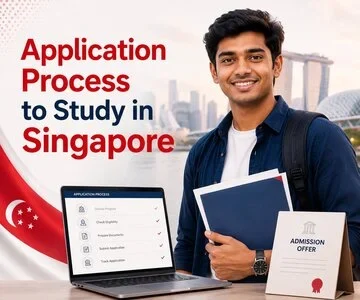
Quick answer: To study in Singapore, apply in two stages. First win admission through the institution's own route: an autonomous university's portal, the polytechnic Direct Admissions Exercise, or a private college's system. Then apply for a Student's Pass through ICA's SOLAR portal using eForm 16, two to three months before your course starts.


The application process to study in Singapore has two distinct stages: admission at a chosen institution, then a Student's Pass from the Immigration and Checkpoints Authority (ICA). The admission portal depends on the institution type, because autonomous universities, polytechnics, and private colleges each run a separate system with its own intake and deadline.
In 2026, Singapore offers three admission routes for international students: the country's six autonomous universities listed by the Ministry of Education (MOE), five polytechnics, and private colleges regulated by the Committee for Private Education (CPE). Each route carries a different fee, intake, and academic profile, so the route chosen shapes every later step.
From our counselling desk, by route: across the Hyderabad and Tirupati files we run each intake, autonomous-university applicants most often stumble on the English band, not the academic cut-off; polytechnic (DAE) families are surprised the diploma-to-degree route costs less than a direct degree; and on the private route we shortlist only EduTrust-certified colleges, because a Private Education Institution (PEI) without EduTrust cannot sponsor the Student's Pass a foreign student needs. Same country, three different first hurdles.
A Singapore application must clear two eligibility gates: academic marks and English proficiency. The academic gate reads your Class 12 percentage or, for postgraduate study, your bachelor's degree; the English gate is met through IELTS or TOEFL. Autonomous universities set the most competitive bars, while polytechnics and private colleges stay more accessible.
The CGPA-as-percentage trap. Indian boards report a CGPA, but Singapore portals often want a percentage. Convert it using your board's official formula, not a rough guess. A wrong conversion can push a strong file below a cut-off it would otherwise clear.
A Singapore application draws on one document set that serves both stages: institutional admission and the Student's Pass. Where the SOLAR upload step requires it, typically for courses of six months or more, that set also includes an ICA medical examination report. Gathering every document once, before either portal opens, keeps both stages moving without a stall.
As of 2026, NUS charges international applicants a S$20 (about Rs 1,479) non-refundable application fee, listed on its Application Fee Payment page. Fees vary widely by route, so a Singapore university application can cost anywhere from a token amount to several hundred dollars depending on where you apply.
As of 2026, Singapore's Immigration and Checkpoints Authority charges a S$60 (about Rs 4,437) Student's Pass issuance fee, set out on its Completion of Formalities and Issuance of Student's Pass page. Two smaller fees and a short online formality complete the study visa, which stays inexpensive next to tuition but strict on timing.
Singapore's NUS undergraduate window for international qualifications runs from early December to late February. The confirmed 2026-27 cycle opened on 3 December 2025 and closed on 23 February 2026, set out on the NUS Office of Admissions Important Dates page. Expect a similar window for August 2027; NUS publishes the exact 2027 dates closer to the intake.
From our counselling desk: In the Hyderabad files we handled for the 2025 intake, the most common delay was not rejection. It was students filing eForm 16 too early, outside ICA's two-to-three-month window, then having to resubmit. A typical slip we see, drawn as an illustrative composite: a student files eForm 16 in March for an August start, three weeks outside ICA's window, and has to resubmit, losing a fortnight. Diarise that window the day you accept your offer.
Everything you need to study abroad, in one place.
Explore articles and guides that help you prepare with confidence, covering scholarship applications, financial planning, and tips for adapting to a new culture. We have built comprehensive resources to get you ready for your educational adventure.
Intakes in Singapore for Indian Students (2026-27): August, January The short answer: Singapore’s public universities run one main undergraduate intake,

Cost of Studying in Singapore for Indian Students
Cost of Studying in Singapore for Indian Students (2026) The cost of studying in Singapore for Indian students in 2026
Study in Singapore After 12th for Indian Students
Study in Singapore After 12th for Indian Students (2026-27): Routes If you’re a Class 12 student eyeing a top Asian