
English-Taught Universities in France
English-Taught Universities in France: Top Options & Fees in 2026 English-taught universities in France give Indian students a real degree
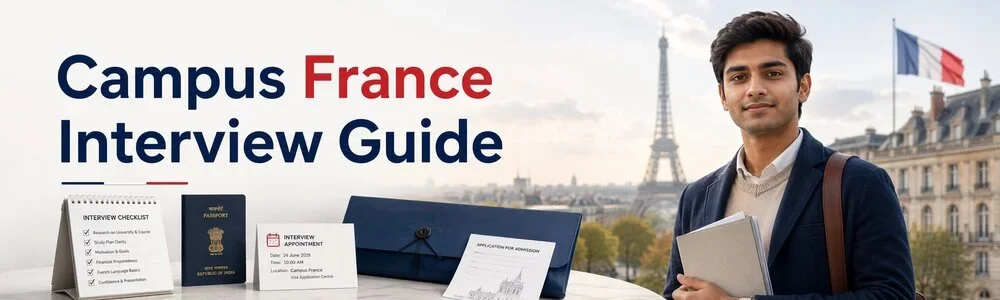

The Campus France interview is a structured academic evaluation conducted before the visa stage for Indian applicants using the Etudes en France procedure. A Campus France advisor assesses study-project coherence and writes an opinion, called an avis, that the French consulate consults. The Etudes en France pathway is set out by Campus France India, Application and Admission Procedure (2026).
The Campus France advisor evaluates five pillars: academic background, course and university fit, motivation for France, financial readiness, and career clarity. Financial readiness carries heavy weight because it directly informs the visa decision. The five-pillar structure aligns with the official interview brief on Campus France, Studying in France (2026).
Insufficient proof of funds is the leading cause of weak Campus France files for Indian applicants, ahead of low grades or weak English. The financial-means requirement is set out by France-Visas, Student long-stay visa (2026). Two failures recur: an applicant cannot explain how funds were accumulated, and parental income proof is thin.
What advisors probe on funds: Who earns the money? Over how long was it saved? Is the loan sanctioned or only applied for? Does the parental income on the ITR match the lifestyle and the savings shown? A file that answers all four in one breath rarely gets a guarded avis.
The Campus France pathway carries three core 2026 charges: the Etudes en France procedure fee, the CVEC student-life contribution, and the VLS-TS validation tax paid after arrival. The CVEC amount for 2026-2027 is set by CVEC, Etudiant.gouv (French Ministry of Higher Education) at EUR 105. All conversions below use a live EUR/INR rate.
Academic-background questions in the Campus France interview probe your grade trend, backlogs, gaps, and the relevance of your prior degree. The advisor uses your answers to test honesty against your uploaded marksheets and the paid Etudes en France procedure. The EEF procedure and its 2024 fee revision are documented by Campus France India, Increase in Etudes en France fees (2024).
I completed my B.Tech in Computer Science from VIT Vellore with an 8.1 CGPA, and I worked for a year as a junior data engineer. I am applying for the Master in Data Science at a French grande ecole because I want to specialise in machine learning for the energy sector, which France leads in Europe.
My bachelor's was in Mechanical Engineering at NIT Trichy, with strong coursework in thermodynamics and manufacturing systems. My final-year project on EV battery cooling pushed me toward a Master in Sustainable Mobility, which is why this French programme fits my background directly.
My third-year average dipped because I took on a heavy elective load alongside a research internship, and I underestimated the time. I corrected it the next year, finishing my final two semesters with an 8.4, and I learned to manage parallel commitments, which the master's workload will demand.
I had two backlogs in second year, in Engineering Mathematics and Signals and Systems, both caused by a medical absence during exams. I cleared both in the supplementary exams the same year, and my transcript shows the final passing grades.
After graduating in 2024, I worked for a year as a business analyst at a Bengaluru fintech firm. That year confirmed I wanted to deepen my analytics skills formally, and the work experience is exactly what this Master in Business Analytics expects from applicants.
During my supply-chain internship at a Pune manufacturing firm, I built a dashboard that cut stock-out reporting time by two days. It showed me I wanted formal training in supply-chain analytics, which is the core of the master's I have applied to at NEOMA Business School.
Course-fit questions test why you chose France over competing destinations and why this specific institution. Strong answers cite sector strength and programme specialisation, not tourism. France hosted 443,500 international students in 2024-2025, per Campus France, Nearly 445,000 international students (2025), which signals a mature higher-education system.
France leads Europe in luxury and fashion management, and my target sector is luxury retail. The country hosts the headquarters of global maisons, and a French master's puts me inside that ecosystem for internships, which no other destination offers at the same depth.
I compared all five. The UK and USA cost far more for a comparable analytics master's, Germany's best options needed German fluency I do not have, and Canada and Australia lacked the specific luxury-analytics specialisation I want. France gave me the right course at a manageable cost in English.
I chose Grenoble Ecole de Management because its Master in Innovation has a six-month industry project and triple accreditation. Its location in the Alpine tech corridor also gives access to deep-tech firms, which matches my goal of working in hardware innovation.
I filtered on three criteria: an English-taught data-science master's, a strong placement record in tech, and fees under EUR 15,000 a year. That left me with four schools, and I ranked them by the relevance of their machine-learning electives to my goal.
I will study in Lyon, France's second-largest student hub and a centre for biotech and software. It has strong public transport, a large international-student community, and it sits two hours from Paris by train, which helps for industry events.
For Toulouse I have budgeted about EUR 800 to EUR 900 a month, covering shared housing at roughly EUR 450, food, transport, and a CAF housing-aid offset I plan to apply for. Toulouse is cheaper than Paris, which is one reason I chose it.
Study-project questions examine whether you understand the programme you applied to, including its modules, its link to your bachelor's, and your two-year plan. The advisor tests depth, not memorised marketing copy. The study-project and visa-validation steps that frame this assessment are described by Campus France, How to validate your long-stay visa (2026).
This Master in Computer Science with an AI specialisation matches my goal of building computer-vision systems. Its second-year track in deep learning, plus a mandatory research thesis, gives me the technical depth I need before I move into an R&D role.
My first semester covers Statistical Learning, Data Structures and Algorithms, Database Systems, and a Python-for-Data-Science lab. I am most looking forward to Statistical Learning because it builds the foundation for the predictive-modelling work I want to do later.
My bachelor's in Electronics gave me a strong base in signal processing, and this Master in Data Science builds directly on it by adding statistical modelling and machine learning. The progression is natural: I move from processing signals to extracting insight from data.
I studied Commerce, but two years in a fashion e-commerce role pulled me toward design and brand strategy. I built a portfolio in my own time, and this Master in Fashion and Luxury Management lets me convert that hands-on interest into formal training.
I expect to gain three things: applied machine-learning skills in Python, the ability to deploy models on cloud platforms, and project experience through the six-month industry placement. Together they prepare me for a data-scientist role in a product company.
Year one is coursework and a semester project; year two is a specialisation track plus a six-month internship that feeds my thesis. I plan to use the internship to build industry contacts in the mechanical-design sector before I graduate.
Finance questions in the Campus France interview verify your sponsor, your tuition awareness, your monthly budget, and your funding source. They carry the heaviest weight because they feed the visa decision directly. The financial-guarantee expectation is set by France-Visas, Studying in France (2026).
My father is sponsoring me. He is a senior bank manager with an annual income of about INR 18 lakh, supported by his salary slips and three years of ITR. We have also taken an SBI education loan of INR 25 lakh, sanctioned, to cover tuition and part of living costs.
My tuition is EUR 12,500 a year, so about EUR 25,000 over the two-year master's, which is roughly INR 27.6 lakh at today's rate. I have the admission letter that confirms this figure, and the loan plus my family's funds cover it fully.
I have planned for about EUR 850 a month: roughly EUR 450 for shared housing, EUR 250 for food, EUR 90 for transport, and the rest for phone and insurance. I will also apply for CAF housing aid, which usually reduces my rent.
I have a sanctioned education loan of INR 22 lakh from HDFC Credila, with my mother as co-applicant and our residential property as collateral. The sanction letter shows the amount, the moratorium period, and the disbursement schedule tied to each semester's fee.
For the first semester I have a confirmed place in a CROUS student residence near my campus in Nantes, at about EUR 350 a month. After that I plan to move to shared private housing with classmates, which is common and cheaper.
I may take up part-time work within the student permit limit to cover small expenses, but my tuition and core living costs are already funded by my loan and family savings. Work will be a supplement, not the source I rely on.
Career questions test whether you have a realistic post-study plan, including the legal stay window and your target roles. As of 2026, master's graduates from India may stay for 12 months (one year), non-renewable, under the APS, now the RECE permit, confirmed by Campus France, Temporary Resident Permit (APS). The window shapes a credible answer.
After my master's I plan to use the 12-month APS, or RECE, permit to gain a year of relevant experience with a French or European firm in data engineering. That experience would let me return to India and join a strong analytics team at a senior level.
Yes, my long-term plan is to return to India. The luxury-retail sector is expanding fast at home, and a French master's plus a year of European experience would let me join a leading Indian brand in a strategy role that simply does not exist for freshers here.
This Master in Renewable Energy gives me the technical depth and the European project experience to move from a junior site-engineer role into renewable-project management. India's solar and wind sectors are scaling fast, and that profile is in short supply.
I am targeting data-analyst and data-scientist roles at firms like Capgemini, Dassault Systemes, or a product startup in Paris during my APS year. Long term, I want a senior analytics role with an Indian e-commerce company.
If my visa is refused, I would request the reason, correct the gap, and reapply for the next intake, since my admission and funding are solid. I am confident my file is complete, but I would treat a refusal as a fixable step, not the end.
I have applied to three programmes through the procedure, and two have already given me offers, so a rejection from my top choice still leaves me with a strong fit. My second offer at a Lyon business school covers the same specialisation I want.
The difference between a weak and a strong Campus France answer is concreteness: weak answers state intent, strong answers attach a named detail or a document. Advisors reward specifics on funding and course fit. The coherence standard this reflects is built into the official Etudes en France procedure published by Campus France India (2026), cited in full in the Sources list below.
Coherence is the match between your spoken answers, your motivation letter, and your CV. A Campus France advisor flags any contradiction, because mismatches signal a file someone else built. The motivation document sits at the core of the Etudes en France submission described by Campus France India (2026), cited in full in the Sources list below.
Applicants should carry a complete document set to the Campus France interview, including transcripts, the EEF fee receipt, admission letters, and financial proof. The fee receipt confirms a paid Etudes en France procedure. The document list follows the official Etudes en France requirements published by Campus France India (2026), cited in full in the Sources list below.
The most damaging Campus France interview mistakes are inconsistent answers, undocumented funds, and overstating part-time work as a funding source. Each one weakens the advisor's written opinion. The procedure's reliance on a coherent, evidenced file is set out by Campus France (2026), cited in full in the Sources list below, which makes consistency the safest strategy.
After the interview, the Campus France advisor finalises an opinion, the applicant proceeds to the France-Visas application and VFS biometrics, and after arrival the long-stay visa is validated online. The validation deadline of three months is set by service-public.gouv.fr (2026), cited in full in the Sources list below. The sequence is procedural and predictable.
A focused 14-day plan covers file review, mock answers, financial-document assembly, and city research. Two weeks is enough when preparation is structured around the five assessment pillars. The interview's place in the timeline is set by Campus France India (2026), cited in full in the Sources list below, which schedules it before the visa stage.
Everything you need to study abroad, in one place.
Explore articles and guides that help you prepare with confidence, covering scholarship applications, financial planning, and tips for adapting to a new culture. We have built comprehensive resources to get you ready for your educational adventure.
English-Taught Universities in France
English-Taught Universities in France: Top Options & Fees in 2026 English-taught universities in France give Indian students a real degree

Scholarships to Study in France for Indian Students
Scholarships to Study in France for Indian Students in 2026 Indian student enrolment in France hit a record level in

Universities in France for International Students
Universities in France for International Students The best universities in France for international students in 2026 are Université PSL, Institut