Australia Student Visa for Indian Students
Australia Student Visa for Indian Students: 2026 Fee, Funds & New Rules The Australia student visa for Indian students is

The Australia admission process for Indian students has seven steps. You shortlist a course, apply, get a Letter of Offer and accept it by signing the written agreement. Then you pay the deposit and OSHC (Overseas Student Health Cover, the student health insurance), get your Confirmation of Enrolment (CoE) and apply for the student visa (Subclass 500). CRICOS is the government’s list of courses open to student-visa holders. The CoE is the university’s official proof that you’re enrolled. From 1 July 2026, the Subclass 500 Student visa costs from AUD 2,500, on top of what you pay the university. Below are the acceptance rules at nine universities, the application fees at seven, and the CoE times they publish. You’ll also see the most a university can charge before your course starts. To build the shortlist, compare the top universities in Australia, then pick a field from our guide to the best courses to study in Australia.
Key Takeaways
Every intake runs the Australia admission process for Indian students in this same order. If a course isn’t on CRICOS, it can’t get you a student visa, so check before you apply.
Still choosing a city or course? Our study in Australia guide compares them.
| Step | What happens | Who acts | Typical time | What you pay |
|---|---|---|---|---|
| 1. Shortlist | Pick CRICOS-registered courses | You | Your pace | Nothing |
| 2. Apply | Send marks, test score and passport | You or your agent | Your pace | Application fee (table below) |
| 3. Letter of Offer | Conditional or unconditional offer arrives | University | A few weeks, longer for postgraduate (Deakin coursework: 2-3 weeks once your file is complete) | Nothing |
| 4. Accept | Sign the written agreement | You | By the offer deadline | Paid with step 5 |
| 5. Deposit + OSHC | Pay the deposit and health cover | You or a parent | At acceptance | Deposit capped at 50% of total tuition (see below) + OSHC |
| 6. CoE | Confirmation of Enrolment issued | University | 2-10 working days at Sydney | Nothing |
| 7. Subclass 500 visa | Apply for the student visa | You, to Home Affairs | Set by Home Affairs | Visa fee from AUD 2,500 (≈ INR 1.68 lakh) |
You control most of these steps. The university acts on only two, the offer (step 3) and the CoE (step 6). The Department of Home Affairs (Australia’s visa department) decides step 7. If a step stalls, chase whoever owns it.
You can start in Semester 1 (February or March) or Semester 2 (July), and some universities also offer trimester or term starts. Admission guides commonly suggest applying about six months before your course starts, and one suggests up to 12. If February is closer than that, look at July. Our Australia intakes guide counts back from each start date.
Among the seven universities below that publish a fee, application fees run from AUD 100 at UTS to AUD 154 at the University of Melbourne. Melbourne’s fee applies to each direct application and isn’t refunded. If you’ve already studied beyond school in India, Melbourne makes you apply through one of its authorised agents.
At Sydney, one fee covers every application you make within a year. At Melbourne and ANU, each application costs a new fee. If Sydney is on your list, put your backup courses there too. If you’re eligible for a scholarship, submit your Sydney application by the deadline. Sydney may consider you for some scholarships automatically, but others may need a separate application.
RMIT strongly encourages some applicants to use an authorised agent. But no agent can guarantee your Student visa. An education agent may advise on the visa itself only if it is also a registered migration agent (an adviser licensed to give Australian visa advice).
Three published entry bars:
Board-by-board detail is in our requirements to study in Australia. At Sydney, your application file includes official documents such as academic certificates and transcripts, proof of English and proof of identity, such as your passport. Depending on your background, Sydney may also ask for a CV. Some programs may also ask for a supplementary form, personal statement or portfolio. The documents checklist for Australia lists every paper you’ll upload.
Many families think a university can ask for any deposit. It can't. Under Australia's student-protection law, the ESOS Act 2000, a university cannot take over 50% of total tuition before the course starts. Exceptions: your family chooses to pay more, or the course runs 25 weeks or less. On a 2-year master's, the cap is about one year's tuition.
Read your Letter of Offer before you accept. It lists your course, its conditions, the fees and your refund rights. An unconditional offer has nothing left to meet. A conditional offer depends on more proof, and it turns unconditional once the university checks what you send.
You don’t have to wait for final results. Melbourne accepts your most recent marks, and Deakin allows early applications in some cases. At UNSW, you can meet an English condition with a test score or by enrolling in UNSW College’s English entry course. RMIT issues a CoE only after you meet the conditions and pay the deposit.
A university must sign a written agreement with you before, or at the same time as, it takes any money for your course. This is the acceptance paper you sign after the offer letter, and each university names it differently. That agreement is a contract, and its refund terms decide what you get back if you or the university pulls out.
Parents: even with the cap, a university can hold up to half the total tuition before the visa decision. Read what your written agreement says about a refused visa before you transfer the money.
You must hold OSHC for your whole time studying in Australia. For policies bought from 1 July 2026, Allianz Care’s published one-student rate, via ANU, is AUD 838 for 12 months and AUD 1,735 for 24 months. RMIT and UQ can include it in the deposit, so check your offer before you buy a separate policy. Our cost of studying in Australia guide puts it beside tuition and rent.
From our counselling desk: Two mistakes repeat every intake, and both came up again in our offer-acceptance briefings for the 2026 intake. Families treat the offer letter as if it were the visa, and they skim the refund terms.
Your CoE gets you to the visa stage, but it isn’t the visa. Home Affairs needs your CoE before it issues a visa. Five rules apply at the visa stage:
So don’t book flights or pay the full year’s tuition on the day your CoE arrives; wait for the visa grant. Our Australia student visa guide has the full fee, funds and document checklist.
Get in Touch
Can I apply to an Australian university before my final results?
Yes. Melbourne lets you apply with your most recent results. Any offer may then be conditional, which means it depends on more proof, such as final results, transcripts or a test score. Send that proof as soon as your results arrive, because the condition stays open until you do.
How long does an Australian Letter of Offer take?
It can take a few weeks, or longer for postgraduate courses. At Deakin, a coursework outcome takes two to three weeks once every required document is in. So send your whole file at once, because a missing paper holds up the result.
Do I pay the tuition deposit before or after the visa?
Before. Your CoE is sent after you accept the Letter of Offer and pay the deposit, and you must include a copy of it in your visa application. For parents: your written agreement is a contract that includes refund terms, so check what it says about a refused visa.
Can my student visa be refused after I have a CoE?
Yes. The CoE proves you’re enrolled, but Home Affairs decides the visa separately. An application without proof of OSHC is refused, and you must still hold a valid CoE when the visa is decided. So don’t change courses while your visa is pending.
Can Indian students apply to Australia without IELTS?
Yes, if your university accepts another test. Curtin, for example, takes PTE Academic and TOEFL iBT, and it sets section minimums as well as a total. On PTE that’s 50 to 54 per section for tests from August 2026. On TOEFL it’s 16 to 19 for tests from June 2026. Check each section score, not just the total.
Ardent Overseas has helped Indian students into Australian universities since 2014, from offices in Hyderabad and Tirupati. Before a family pays a deposit, our study in Australia consultants in Hyderabad check each step of the Australia admission process for Indian students: the offer’s conditions, its refund terms, and the CoE timing against the intake date.
Everything you need to study abroad, in one place.
Explore articles and guides that help you prepare with confidence, covering scholarship applications, financial planning, and tips for adapting to a new culture. We have built comprehensive resources to get you ready for your educational adventure.
Australia Student Visa for Indian Students
Australia Student Visa for Indian Students: 2026 Fee, Funds & New Rules The Australia student visa for Indian students is

Top Universities in Australia for Indian Students
Top Universities in Australia for Indian Students (2027 Rankings and Fees) The top universities in Australia for Indian students in
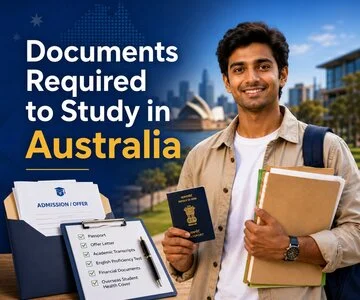
Documents Required to Study in Australia for Indian Students
Documents Required to Study in Australia for Indian Students: 2026 Visa Checklist The documents required to study in Australia for