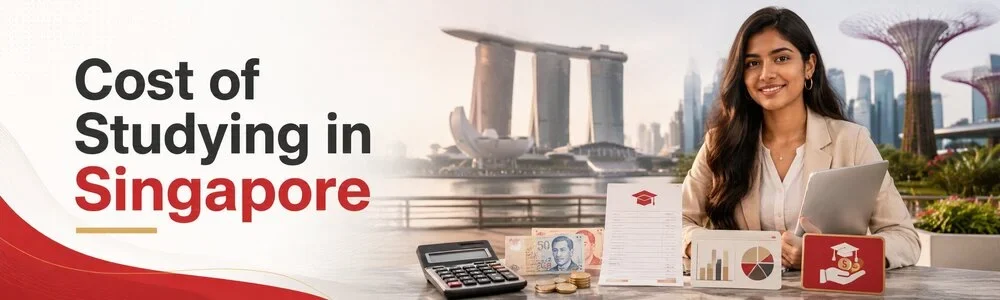
Cost of Studying in Singapore for Indian Students (2026)

Last Updated on: July 7, 2026

Cost of Studying in Singapore for Indian Students

The cost of studying in Singapore for Indian students in 2026 is roughly S$31,000 to S$78,000 a year (approx. INR 23 to 57 lakh) for a standard undergraduate degree, covering tuition, living, and visa fees, with medicine and music running far higher. One detail decides almost everything: Indian students are “All Other International Students,” not ASEAN, so the Tuition Grant rate that applies to you starts at S$21,400 a year (approx. INR 15.62 lakh), per the Nanyang Technological University, Tuition Fees guide (2026). This guide gives you and your family every number in S$ and INR, by university and by scenario; for how those fees fit the bigger decision to study in Singapore, start with our country hub.

All INR conversions use the live Google-published rate captured on 2026-06-29: S$1 ≈ ₹73.01. Rates fluctuate intraday; figures are indicative.

Which fee tier applies to Indian students? Singapore universities publish three international rates per course: ASEAN International Students (subsidised), All Other International Students (subsidised), and non-subsidised (no grant). India is not an ASEAN member, so Indian students should read the "All Other International Students" column if they take the Tuition Grant, or the non-subsidised column if they do not. Never budget off the ASEAN figure; it does not apply to you.


Written by
Senior Counsellor for the Middle East and Asian countries
Nagesh Danagalla helps Indian students with university selection, admissions, and student visas for Middle East and Asian destinations at AOEC India. A B.Tech and M.Tech graduate of JNTU Hyderabad, he brings destination-specific expertise in admissions and visa documentation.
5 Years, 320 students counselled
Reviewed by
Managing Director
Mr. Kongara Sridhar, Director of AOEC India, has over 12 years of experience in overseas education consulting, admissions, and student visa guidance.
Over 12 years Experience

Key Takeaways

  • A standard undergraduate year costs about S$31,000-48,000 (approx. INR 23-35 lakh) with the Tuition Grant, or S$43,000-78,000 (approx. INR 32-57 lakh) without it.
  • Indian students pay the “All Other International Students” rate: from S$21,400/yr with the grant, or S$36,350-40,600 non-subsidised at NTU.
  • NUS charges Indian students S$21,400 (Computing) to S$30,450 (Law) with the grant; Medicine is S$87,800.
  • Indian students may apply for the MOE Tuition Grant; if offered and accepted, it ties you to a 3-year bond working in Singapore after graduation.
  • NUS estimates living costs at S$6,000/yr (approx. INR 4.38 lakh) excluding rent; on-campus rooms add S$4,000-S$10,290.
  • A Student’s Pass carries a S$60 issuance fee (approx. INR 4,381), plus an optional S$30 Multiple Journey Visa.

The total cost of studying in Singapore for Indian students in 2026 runs about S$31,000 to S$78,000 per year (approx. INR 23 to 57 lakh) for a standard undergraduate degree, combining tuition, living, and visa fees. At the high end, SUTD's non-subsidised tuition reaches S$62,076, per the SUTD Tuition Fees page (2026), while medicine, dentistry and music can cost far more. The Tuition Grant decision sets where in that band you land.
Because the range is wide, it helps to think in scenarios rather than one number. The table below adds tuition (at the Indian “All Other IS” rate) to NUS’s living estimate, on-campus housing, and Student’s Pass fees. Medicine, dentistry, and music sit in a different league, so they get their own row.

Scenario (per year)Total in SGDTotal in INR
Standard UG, with Tuition GrantS$31,460-47,950INR 23.0-35.0 lakh
Standard UG, without grantS$43,460-78,426INR 31.7-57.3 lakh
Medicine / dentistry / music, with grantup to S$107,600up to INR 78.6 lakh
Medicine / dentistry / music, without grantup to S$206,500up to INR 150.8 lakh

In our experience, families we counsel underestimate accommodation and overestimate how much a part-time job will claw back. Build your Singapore study budget in INR around the right row above, then add a buffer for a weak rupee. The next section breaks tuition down university by university.

How much is tuition at NUS, NTU, SMU and SUTD?

Undergraduate tuition fees in Singapore for Indian students, with the MOE Tuition Grant, range from about S$21,400 a year to S$31,600 for standard degrees, rising to S$87,800 for medicine. At SMU, the subsidised "Other International Students" rate is S$26,200 for most degrees, per the Singapore Management University, Tuition Fees page (2026). Non-subsidised fees roughly double these figures.

Singapore university fees for international students come in two flavours for Indian applicants: subsidised (“All Other International Students” with the Tuition Grant) and non-subsidised (full fees, no grant). The table below shows the Indian rate at four major Singapore autonomous universities commonly shortlisted by Indian applicants: NUS, NTU, SMU and SUTD, for a standard degree, plus the estimated all-in yearly total at the subsidised rate.

UniversityTuition with grantTuition without grantEst. total/yr with grantEst. total/yr without grant
NUS (Computing)S$21,400S$39,700S$31,460-37,750 (INR 23.0-27.6 lakh)S$49,760-56,050 (INR 36.3-40.9 lakh)
NTU (general)S$21,400S$36,350S$31,460-37,750 (INR 23.0-27.6 lakh)S$46,410-52,700 (INR 33.9-38.5 lakh)
SMU (most degrees)S$26,200S$47,700S$36,260-42,550 (INR 26.5-31.1 lakh)S$57,760-64,050 (INR 42.2-46.8 lakh)
SUTDS$31,600S$62,076S$41,660-47,950 (INR 30.4-35.0 lakh)S$72,136-78,426 (INR 52.7-57.3 lakh)

So the cheapest standard route for an Indian student is NUS or NTU at S$21,400 a year with the grant; SUTD is the priciest of the four. Note that SMU Law sits higher than its other degrees, at S$30,450 subsidised and S$56,150 non-subsidised. Always compare the actual “All Other IS” number for your specific course, not the headline brand, and our counsellors can help you weigh the top universities in Singapore for your budget.

NUS fees in detail (AY2026/27, All Other International Students)

NUS programmeWith grant (All Other IS)Without grant
Computing / Design & EngineeringS$21,400 (INR 15.62 lakh)S$39,700 (INR 28.98 lakh)
Humanities & SciencesS$21,400 (INR 15.62 lakh)S$36,650 (INR 26.76 lakh)
BusinessS$22,200 (INR 16.21 lakh)S$33,400 (INR 24.39 lakh)
LawS$30,450 (INR 22.23 lakh)S$44,450 (INR 32.45 lakh)
MusicS$56,850 (INR 41.51 lakh)S$147,850 (INR 107.95 lakh)
Medicine (except Nursing)S$87,800 (INR 64.10 lakh)S$190,150 (INR 138.81 lakh)

These NUS figures come straight from the official NUS 2026/27 registrar tuition fee schedule and apply to students starting this year. The pattern holds across Singapore: a typical Indian student in computing, engineering, or the arts pays close to S$21,400 with the grant, while professional degrees climb steeply.

What is the MOE Tuition Grant, and is the 3-year bond worth it?

Indian students may apply for the MOE Tuition Grant; it is not automatic. If the grant is offered and accepted, it reduces tuition to the "All Other International Students" subsidised rate and comes with a 3-year service bond requiring graduates to work in Singapore after graduation, per the Ministry of Education, Tuition Grant Scheme bond matters page (2026). The subsidy roughly halves tuition for most courses.

This is the single biggest decision in the whole cost of studying in Singapore for Indian students, so let’s slow down. The MOE Tuition Grant for international students (the government tuition subsidy) is open to non-ASEAN applicants like you, but it is awarded on application, not automatic, and it is not free money. In return for the lower fee, you accept a service obligation.

The bond, in plain terms: if you take the Tuition Grant, you must serve a 3-year bond working in Singapore after graduation. That can be a strong launchpad into Singapore's job market, or a constraint if your family always planned for you to return to India straight after the degree.

So is it worth it? Here is the honest framing we give parents reading this. If your child wants to build a career in Singapore, the grant is close to a no-brainer; the bond is something they would do voluntarily anyway. If the plan is to come home immediately, weigh the saved lakhs against three years of committed employment abroad. There is no universal right answer, only the right answer for your family’s goals.

For families chasing affordable study in Singapore, the grant is usually what makes the budget work. Without it, only well-funded households or scholarship holders comfortably clear the full-fee band. Run both numbers before you decide.

How much will you spend on living costs in Singapore?

Living costs in Singapore for students are estimated at S$6,000 per year excluding accommodation (approx. INR 4.38 lakh), with on-campus housing adding S$4,000 to S$10,290 annually, per the National University of Singapore, Living Costs guide (2026). Rent is the largest variable in a student's monthly spend.

Tuition gets the headlines, but the cost of living in Singapore for students is what wears down a budget month after month. The good news: it is more predictable than rent in London or Sydney, because campus housing is widely available.

NUS breaks its S$6,000 non-accommodation estimate into clear line items, which makes monthly planning easy. These are guideline figures; a frugal student spends less, a social one spends more.

  • Meals: S$2,600 a year (approx. INR 1.90 lakh)
  • Personal expenses: S$2,200 a year (approx. INR 1.61 lakh)
  • Transport within Singapore: S$800 a year (approx. INR 58,408)
  • Books and supplies: S$400 a year (approx. INR 29,204)

Add accommodation on top. On-campus rooms run S$4,000 to S$10,290 a year (approx. INR 2.92 to 7.51 lakh) depending on the hostel and room type. Off-campus private rentals can run higher, especially near central campuses, so most first-year Indian students start in a hostel and move out later once they know the city.

What are the Student’s Pass fees and how do you apply?

The Student's Pass is Singapore's student visa, and in 2026 it carries a S$60 issuance fee (approx. INR 4,381), per the Immigration and Checkpoints Authority, Student's Pass formalities page (2026). An optional Multiple Journey Visa adds a further S$30 (approx. INR 2,190) for students who travel home and back.

The Singapore student visa cost is refreshingly low compared with tuition, but the process matters. You apply through SOLAR (the online Student’s Pass application system) once your university registers your admission, and you must complete it before you arrive.

Fee itemAmountWhen
Student’s Pass issuance feeS$60 (approx. INR 4,381)On collection
Multiple Journey Visa (optional)S$30 (approx. INR 2,190)If applicable

Here is the realistic order of events. Knowing these Student’s Pass fees and steps up front saves families a scramble, and our team walks students through the Singapore student visa process when offers arrive.

  1. Your university registers you and creates a SOLAR record.
  2. You log in to SOLAR, complete the e-Form, and submit the required documents.
  3. You receive an In-Principle Approval (IPA) letter (the pre-approval that lets you travel and complete formalities).
  4. After arriving, you complete a medical examination and biometrics with the ICA (Immigration and Checkpoints Authority).
  5. You collect the Student’s Pass and pay the issuance fee.

What hidden costs catch Indian families off guard?

The expenses for studying in Singapore reach beyond tuition and rent. Compulsory university fees, a pre-arrival medical examination, mandatory health insurance, and English-test charges each add a modest sum, but together they can equal a full month of living costs if a family does not budget for them in advance.

Most budgets break not on tuition but on the costs nobody warned you about. Across the expenses for studying in Singapore, these are the line items Indian families most often forget when they first plan.

  • GST on tuition: the international-student fees quoted above already include 9% Goods and Services Tax, so the headline number is what you pay; do not add tax on top.
  • Compulsory miscellaneous fees: most Singapore universities add a small compulsory annual fee, often a few hundred dollars, on top of tuition; the exact amount varies by university and appears on your offer letter or student bill.
  • Medical examination: required before the Student’s Pass is issued; budget for a one-off clinic charge.
  • Health insurance: universities require coverage; build a yearly premium into your plan.
  • English-test fees: IELTS or TOEFL costs are paid in India before you even apply. If you have not booked yet, check the IELTS requirements for Singapore universities and their fees.
  • Multiple Journey Visa: the optional add-on if you plan to travel home and back during the year.

None of these is huge alone. Together, they can quietly add the equivalent of a month’s living costs, so we always have families pad their first-year budget by a buffer rather than planning to the last rupee.

Which scholarships and funding can cut your Singapore bill?

Scholarships in Singapore for Indian students centre on three funding routes: the MOE Tuition Grant, postgraduate awards such as the Singapore International Graduate Award (SINGA), and limited part-time work, per the SMU College of Graduate Research Studies, SINGA programme page (2026). SINGA pays a monthly stipend plus full tuition for PhD candidates.

Funding for affordable study in Singapore is not as scholarship-rich as the UK or US, so it pays to know your real options. For doctoral students, SINGA is the standout: it covers full subsidised tuition, pays a monthly stipend of S$2,000 (approx. INR 1.46 lakh) rising to S$2,500 (approx. INR 1.83 lakh) after a qualifying exam, and adds one-off grants for airfare and settling in, for up to four years.

MOE Tuition Grant
 
Government subsidy for selected full-time diploma and undergraduate courses that roughly halves tuition in exchange for a 3-year service bond. The most common route to a workable budget for Indian undergraduates.
SINGA
 
Full tuition, a monthly stipend, plus one-off airfare and settling-in grants, for up to four years. Singapore’s most generous research award.
Part-time work
 
A capped weekly job during term. Useful for pocket money, but it covers only part of living costs (see the next section).

Postgraduate research students: the Tuition Grant covers selected full-time diploma and undergraduate study only. If you are heading into a research master’s or PhD, look instead at the MOE Service Obligation Scheme, which subsidises selected postgraduate research courses at NUS, NTU and SMU in exchange for a similar 3-year bond.

Beyond these, individual universities run merit awards that change year to year. To map every grant, loan, and award against your family’s budget, explore scholarships to study in Singapore with a counsellor before you commit.

Can part-time work cover your costs in Singapore?

Part-time work in Singapore for students is capped at a maximum of 16 hours per week during term, with full-time work permitted during scheduled vacations, per the Ministry of Manpower, work pass exemption for foreign students page (2026). This limit means a term-time job offsets, but rarely replaces, living costs.

This is where optimism meets arithmetic. Part-time work in Singapore for students is allowed at up to 16 hours a week during term, and full-time during vacation, under MOM (Ministry of Manpower) rules, provided your university qualifies for the exemption.

Let’s do the honest math. Even at a generous casual wage, 16 hours a week over a term covers a useful slice of the S$6,000 annual living cost, not the whole thing, and certainly not tuition. Vacation work helps more, but holidays are short. Treat a job as relief for meals and personal spending, not as a tuition plan.

Our honest takeaway for parents: budget as if your child earns nothing, then treat any part-time income as a bonus. Families who plan that way never get caught short mid-semester.

How we sourced these figures

Every figure in this guide was taken on 29 June 2026 from official sources: the NUS, NTU, SMU and SUTD fee pages, the Ministry of Education, the Immigration and Checkpoints Authority, and the Ministry of Manpower. Tuition uses the "All Other International Students" tier that applies to Indian nationals.

A few notes so you can trust and recheck the numbers. “With grant” means the subsidised All Other International Students rate, which requires the 3-year bond. International-student tuition fees are quoted inclusive of 9% Goods and Services Tax, so the figures are what you actually pay. INR conversions use the live Google rate of S$1 to INR 73.01 captured on 29 June 2026, and currency moves daily, so treat the rupee figures as indicative. The figures were reviewed against Ardent Overseas counselling casework with Indian families applying to Singapore.

Get in Touch

Frequently Asked Questions

Yes. Indian students are international applicants and may apply for the MOE Tuition Grant. It is not automatic. If the grant is offered and accepted, tuition is charged at the “All Other International Students” subsidised rate and the student must serve a 3-year bond after graduation.

With the Tuition Grant, NUS charges Indian students about S$21,400 a year (approx. INR 15.62 lakh) for computing or engineering, S$22,200 for business, and S$30,450 for law. Medicine is far higher at S$87,800. Without the grant, these roughly double, and medicine reaches S$190,150.

For a standard degree with the Tuition Grant, NUS and NTU are the most affordable at S$21,400 a year (approx. INR 15.62 lakh), ahead of SMU at S$26,200 and SUTD at S$31,600. Add roughly S$10,000-16,300 a year for living and housing to get your all-in cost.

You pay the non-subsidised rate and carry no bond, leaving you free to work anywhere after graduation. For standard degrees that means roughly S$33,400 to S$62,076 a year in tuition instead of the subsidised figure, so most families who skip the grant are either well-funded or hold a scholarship.

No. The 16-hour weekly term-time cap means a job can ease meal and personal spending, but it will not cover tuition or even all of the S$6,000 annual living cost. Plan your budget as if part-time earnings are zero, then treat anything you earn as a welcome bonus.

Often, yes, especially with the Tuition Grant, which can pull standard tuition below typical UK or Australian international fees. Living costs are comparable to a mid-tier UK city. Without the grant, full-fee Singapore courses can match or exceed Western rates, so the answer hinges on your grant eligibility.

Singapore does not publish a single fixed proof-of-funds figure; universities and the ICA assess that you can meet tuition plus living costs. Using NUS guideline figures, the living-and-housing portion alone is roughly S$10,000 to S$16,000 a year (approx. INR 7.3-11.7 lakh), on top of one year of tuition.

For a grant-supported standard undergraduate, plan S$31,000-48,000 a year (approx. INR 23-35 lakh) including tuition, living, and fees. Without the grant, budget S$43,000-78,000 (approx. INR 32-57 lakh). Medicine and music run far higher. Add a buffer for hidden costs and a weak rupee.

The cost of studying in Singapore for Indian students really comes down to one tier and one decision: read the “All Other International Students” rate, then choose whether the Tuition Grant and its 3-year bond fit your family’s plans. Get those right and a standard degree lands in a manageable INR 23-35 lakh band with the grant. Ardent Overseas has guided Indian families through Singapore admissions from our offices in Hyderabad and Tirupati, and we believe in showing you honest, sourced numbers rather than rounded guesses. You can read how we verify every figure in our editorial standards.

Sources

Official sources first, then reputable third-party.

Everything you need to study abroad, in one place.

Explore articles and guides that help you prepare with confidence, covering scholarship applications, financial planning, and tips for adapting to a new culture. We have built comprehensive resources to get you ready for your educational adventure.

Masters in Singapore for Indian Students

Masters in Singapore

Masters in Singapore for Indian Students 2026: Fees, Universities, Eligibility & ROI Last Updated on: July 7, 2026 Thinking about