Masters in Dubai for Indian Students (2026): Degrees and Fees in Rupees

Masters in Dubai for Indian Students

masters in Dubai for Indian students means studying at a branch campus of a UK, Australian, or Indian university, usually finishing in one year, and stepping straight into a tax-free job market 3 hours from home. For 2026 entry, verified programme fees run from AED 76,491 to AED 174,509 (about INR 19.7 lakh to INR 45.0 lakh). What sets this guide apart: every fee below is pulled from the campus’s own 2026 fee page, every rupee figure uses today’s live rate, and we connect the degree to the GPA-based Golden Visa route that most articles skip.

Written by
Senior Counsellor for the Middle East and Asian countries
Nagesh Danagalla helps Indian students with university selection, admissions, and student visas for Middle East and Asian destinations at AOEC India. A B.Tech and M.Tech graduate of JNTU Hyderabad, he brings destination-specific expertise in admissions and visa documentation.
5 Years, 320 students counselled
Reviewed by
Managing Director
Mr. Kongara Sridhar, Director of AOEC India, has over 12 years of experience in overseas education consulting, admissions, and student visa guidance.
Over 12 years Experience

Key Takeaways

  • A Dubai master’s is usually a 1-year branch-campus degree from a UK or Australian university, taught in English and regulated locally.
  • Verified 2026 programme fees range from AED 76,491 (about INR 19.7 lakh) at Middlesex Dubai to AED 174,509 per year (about INR 45.0 lakh) at Birmingham Dubai.
  • Manipal Dubai’s 2-year MBA costs AED 57,750 per year (about INR 14.9 lakh), so the annual outlay is lower but the payback is slower.
  • Most MSc programmes waive the GMAT and GRE; a few MBAs ask for a GMAT or work experience instead.
  • High-performing graduates may qualify for the 10-year UAE Golden Visa, but the GPA threshold depends on the university’s classification: 3.5 for a UAE Class A university and 3.8 for Class B, with the degree attested and graduation within two years.
  • Dubai income is tax-free, so advertised salaries near AED 12,000 per month land in your account in full.

A master's in Dubai is usually delivered by a local university or an international branch campus. Many Dubai branch campuses operate under the KHDA, while some institutions and programmes also hold UAE Ministry of Education or CAA accreditation (Commission for Academic Accreditation, 2026). Indian students should check the KHDA listing, CAA or MoE status where relevant, and AIU equivalence for India.

master’s in Dubai is rarely a brand-new local university. Far more often it’s a branch campus, a satellite of a foreign university that runs the parent’s syllabus and awards the parent’s degree. Heriot-Watt and Birmingham bring UK degrees; Wollongong brings an Australian one; Manipal and SP Jain bring Indian-rooted programmes.

Recognition is where Indian families get tripped up, so be precise about who regulates what. The KHDA (Knowledge and Human Development Authority) is Dubai’s own education regulator, and it oversees most free-zone branch campuses. The CAA sits at the federal level under the Ministry of Higher Education and Scientific Research (MOHESR). A branch campus may be quality-assured through KHDA’s route or hold CAA accreditation, so confirm which applies to your specific programme, not just the university name.

Three things make postgraduate study in Dubai different from the same degree in India or the UK. The courses are usually English-taught, so there’s no language barrier. Many run one year, not two. And the city itself is the pull: a tax-free salary at the end, with no long-haul flight separating you from family in India. Just don’t assume a Dubai degree is automatically recognised everywhere; for India, plan for AIU equivalence.

For the wider picture of campuses, costs, and visas, our guide to study in Dubai for Indian students sets the scene; this article zooms into the master’s-level decision.

Which universities offer the best master’s in Dubai for Indian students in 2026?

The strongest campuses for a master's in Dubai sit across UK, Australian, and Indian-origin universities, each awarding its parent degree. For 2026 entry, the University of Birmingham Dubai runs its MSc Computer Science as a one-year full-time programme priced at AED 174,509 per year (University of Birmingham Dubai). Campus choice shapes both fee and recognition.

Read the duration column alongside the fee when you compare a masters degree in Dubai. A one-year UK branch course and a two-year Indian-origin one are not the same commitment, even when the annual number looks similar. Every figure below comes from the campus’s own fee page.

UniversityFlagship master’s (degree type)Duration2026 tuition (AED to INR)Best for
University of Birmingham DubaiMSc Computer Science1 yrAED 174,509/yr (about INR 45.0 lakh)UK degree, tech and CS
Heriot-Watt University DubaiMSc Data Science1 yrAED 113,685 (about INR 29.3 lakh)UK STEM, data and analytics
Middlesex University DubaiMBA / MSc1 yrMBA AED 84,872 (about INR 21.9 lakh); MSc from AED 76,491Affordable UK-linked
SP Jain School of Global ManagementGlobal MBA~1 yr (Dubai + Singapore)USD 44,020Global MBA, 2+ yrs work-exp
Manipal University Dubai (MAHE)MBA / MSc2 yrsMBA AED 57,750/yr (about INR 14.9 lakh)Indian-origin, lower annual outlay
BITS Pilani DubaiM.E. (engineering)2 yrsAED 16,800/sem, about AED 67,200 total (about INR 17.3 lakh)Indian-origin engineering
University of Wollongong in Dubai (UOWD)MBA / MSc15-24 months by programme (MBA 24 months / 12 subjects)MBA AED 9,597.26/subject (about INR 2.47 lakh)Australian degree

Those seven are the names Indian families meet most, but the shortlist runs longer. Also worth a look: University of Dubai, Amity University Dubai, Canadian University Dubai, Curtin University Dubai, and the American University in Dubai (AUD) all run master’s programmes. For the full campus shortlist with locations and strengths, see our guide to the universities in Dubai for Indian students. The MBA is one degree among several here, so weigh it against the MSc routes before you fix on a campus.

One year or two years? How master’s length changes what you really pay

Master's length in Dubai changes the real cost as much as the sticker fee, because it decides when earning starts. A one-year UK or Australian branch degree returns a graduate to a tax-free salary roughly twelve months sooner than a two-year Indian-origin route. The figures above show the trade; the timing decides the payback.

The cheaper-looking degree can cost you more, and length is why. A one-year master’s in Dubai from a UK or Australian branch campus finishes fast and puts you back on a salary a year sooner. A two-year Indian-origin master’s at Manipal or BITS Pilani Dubai spreads a lighter annual fee across twice the calendar. That is gentler on the family budget, but it pushes back the day you start earning.

Parents: the opportunity-cost math is where this decision really sits. Finish a one-year MSc and you could be drawing a Dubai salary in month 13. Take the two-year route and that first pay cheque arrives in month 25. If cash flow is tight this year, the lower annual fee buys breathing room. If the year is fundable, the faster degree usually pays itself back sooner.

  • One-year route (UK/Australian branch): higher annual fee, faster payback, earning by month 13.
  • Two-year route (Indian-origin): lighter annual outlay, slower payback, earning by month 25.
  • The real question: can your family fund a single intense year, or is a spread bill easier this year?

What does a master’s in Dubai cost all-in, in rupees?

A master's in Dubai costs tuition plus living expenses, and the living side is where families under-budget. In 2026, Numbeo lists a one-bedroom flat outside the centre near AED 5,269 per month, about INR 1.36 lakh, which most students cut by sharing (Numbeo, Jun 2026). Beyond the fee, a realistic monthly float keeps the budget honest.

Parents: tuition is only half the picture when you plan the budget. Tuition itself sits in the comparison table above; this table is everything around it.

Cost itemTypical amount (AED)INR approx.Notes
TuitionVaries by universitySee the comparison table aboveOne-off or annual by campus
Accommodation1-BR outside centre ~AED 5,269/mo; sharing lessAbout INR 1.36 lakh/mo (whole flat)Range AED 4,000-7,000; share to cut it, per Numbeo
Food / groceriesAED 740-1,003/moAbout INR 19,100-25,900/moCook-at-home; according to Numbeo
Transport (student Nol)From AED 115/moAbout INR 2,960/moDiscounted student Nol pass; more for added zones
Health insuranceAED 650-2,500/yrAbout INR 17,000-64,000/yrDHA minimum to group plan; per specialist insurer
Student visa + Emirates IDBilled by your university sponsorVariesOne-off bundle; see the cost guide
Flights to IndiaFrom INR 12,807 one-wayIndicative; 1-2 return trips/yr

So beyond tuition, plan for roughly AED 3,000 to 5,000 a month (about INR 77,000 to 1.29 lakh) once rent, food, transport, and insurance are added, with flights on top. The student-visa and Emirates ID bundle is a one-off charge billed by your sponsoring university, so we don’t invent a number for it. For the full monthly breakdown by university and lifestyle, see our guide to the cost of studying in Dubai for Indian students. If you are funding through a bank, work out the loan math with HDFC Credila, Avanse, or SBI early.

Are scholarships available for Indian students doing a master’s in Dubai?

Yes. Most Dubai branch campuses run merit scholarships that cut postgraduate tuition by a fixed percentage rather than paying cash. For 2026 entry, the University of Birmingham Dubai offers a Postgraduate Chancellor's Academic Merit Scholarship of up to 30% per year (University of Birmingham Dubai). These awards reward your bachelor's result, not financial need.

Parents will like this part: a merit scholarship is a tuition discount applied before you pay, so it lowers the fee in the table above directly. Most reward your bachelor’s grade, and a few add a discount simply for paying the year in full. The verified 2026 schemes look like this:

UniversityScholarship or discountVerified 2026 valueNotes
University of Birmingham DubaiPG Chancellor’s Academic Merit30% (First Class / 3.7 GPA); 20% (2:1 / 3.0 GPA)Plus AED 5,000 alumni top-up and a 10% “Secure Your Spot” award for UAE residents
Heriot-Watt University DubaiPG Merit Scholarship; full-payment discountMerit assessed case-by-case; 3% for paying the year in fullMerit value not published; ask the recruitment team
Middlesex University DubaiStudy grants; full-payment discount20-25% grants; 3% for full paymentAlumni 25%, Professional and Corporate 20%
Manipal University Dubai (MAHE)International merit scholarshipUp to 50% in year oneBased on location and grade; renewable on results
University of Wollongong in Dubai (UOWD)Master’s Academic Scholarship15-25% tuition waiver each trimesterDoes not cover living costs or books

One caution for the family budget: these are tuition waivers, not living stipends, so you still plan for rent and daily costs separately. Merit awards usually apply in year one and renew only if your grades hold. For the full Dubai scholarship picture across every campus, and how to keep a waiver if your marks slip, see our guide to scholarships in Dubai for Indian students.

What do Dubai master’s programmes expect: marks, IELTS, work experience, GMAT?

Master's in Dubai entry requirements centre on a recognised bachelor's degree, an English-language score, and, for some MBAs, work experience. For 2026 entry, the University of Birmingham Dubai sets a 2:2 honours degree bar for its MSc Computer Science (University of Birmingham Dubai). Postgraduate bars sit above undergraduate ones, which changes how you prepare.

Postgraduate entry works differently from undergraduate entry, and that’s the first thing to grasp. As a postgraduate applicant you’re judged on your bachelor’s result, not your Class 12 marks. For 2026 entry, Birmingham Dubai’s MSc Computer Science needs a 2:2 honours degree (a UK lower-second classification, roughly 50-60%), which is typical for UK branch MSc programmes. The master’s in Dubai entry requirements usually break down like this:

  • Bachelor’s grade: a recognised degree in a relevant field, with a 2:2 honours bar common on UK branch MSc routes.
  • English score: an IELTS, PTE, or TOEFL result at the postgraduate band the campus sets. Bands vary by programme, so confirm the exact number with an adviser before you book the test.
  • Work experience: required for some MBAs. SP Jain’s Global MBA, for instance, looks for two or more years of work experience.
  • GMAT or GRE: waived on most MSc routes, asked for on some MBA routes.

That last point is the one families ask about most. Yes, you can do a masters in Dubai without GMAT on most MSc programmes: the GMAT and GRE are waived and your bachelor’s result carries the weight. Some MBA in Dubai and Executive MBA programmes still want a GMAT or accept strong work experience instead. So if a competitive test score worries you, the MSc route sidesteps it entirely.

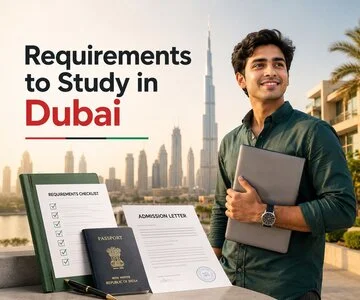
Keep one document set ready before you apply. The summary checklist below covers what nearly every campus asks for:

  • Valid passport
  • Academic transcripts
  • Bachelor’s degree certificate
  • IELTS, PTE, or TOEFL score (if the programme requires one)
  • Statement of purpose (SOP)
  • CV or resume
  • Letters of recommendation (LORs)
  • Attestation of certificates (official verification of your degree documents for use in the UAE)
  • Financial documents

The full attestation walkthrough, with the order of MEA and UAE Embassy stamps, sits in our guide to the requirements to study in Dubai for Indian students, so we won’t repeat the steps here.

Can a Dubai master’s put you on the 10-year Golden Visa track?

A Dubai master's can open a direct route to long-term UAE residency for high-performing graduates. In 2026, university graduates can get a 10-year Golden Visa with a GPA of 3.5 or above from a UAE Class A university, or 3.8 from a Class B university, within two years of graduating (Abu Dhabi Government (ADDED)). Academic performance becomes a residency asset.

This is the post-master’s pathway most articles miss, and your grades alone can earn it. In 2026, a UAE university graduate can qualify with a bachelor’s, master’s, or PhD from a Ministry-accredited Class A or Class B university: GPA 3.5 or above for Class A, and 3.8 or above for Class B, within two years of graduation and with the degree attested. A separate top-100 international-university route exists, but ADDED lists that route for bachelor’s graduates only.

3.5+ GPA

Class A university (graduate route) ADDED, 2026

3.8+ GPA

Class B university (graduate route) ADDED, 2026

2 years

Window after graduation to apply ADDED, 2026

One practical note for Indian graduates: some pathways ask for a KHDA equivalency certificate (official confirmation your degree matches a UAE qualification level) or a valid residence permit in hand. If high-paid employment, rather than grades, is your route to long-term residency, that runs on salary thresholds, which we cover in the next section.

Can Indian students stay in Dubai after a master’s to find a job?

Indian graduates can stay in Dubai to job-hunt, but through a self-sponsored visit visa rather than an automatic work permit. As of 2026, the UAE jobseeker visit visa is issued for 60, 90, or 120 days with no host or sponsor required (Government of the UAE). Planning the switch early avoids a gap in status.

Dubai differs from the UK or Canada here, and parents should note it. In 2026, the UAE has no Western-style automatic post-study work permit, so a Dubai master’s does not hand you a two-year stay-back the way a UK degree does. You bridge the gap yourself with the jobseeker visit visa, which is self-sponsored, so no employer needs to file it for you.

Your post-study path runs in two steps:

  • Job-hunt phase: apply for the self-sponsored UAE jobseeker visit visa, valid 60, 90, or 120 days, and search without a sponsor.
  • Employment phase: once you have an offer, convert to an employer-sponsored work visa, which your new company files.

Two salary-based residencies sit above a standard work visa, and they reward strong earners. In 2026, the UAE Golden Visa for skilled professionals is a 10-year residence visa requiring a minimum monthly basic salary of AED 30,000 (about INR 7.7 lakh) and at least a bachelor’s degree. A step below it, the UAE Green Visa is a renewable 5-year residency for skilled employees on skill levels 1 to 3, holding at least a bachelor’s degree and earning a minimum AED 15,000 per month (about INR 3.9 lakh). Plan the handoff from the student route to the work route before your studies end, so you do not fall out of status while job-hunting.

What do master’s graduates earn in Dubai, and does the degree pay for itself?

Master's-level salaries in Dubai cluster around AED 12,000 per month for established professional roles, with no income tax deducted. As of mid-2026, the average advertised salary for a project manager in Dubai is around AED 12,212 per month, according to Indeed, from 992 reported salaries (Indeed). Tax-free pay changes the payback math.

Parents reading this want the numbers first. The figures below are advertised averages from Indeed, dated and sample-sized, so treat them as indicative, not guaranteed offers. What makes Dubai different is the VAT-only tax system: no personal income tax, so the salary you see is roughly the salary you keep.

RoleAvg monthly (AED)INR (approx.)Sample / date
Project ManagerAED 12,212INR 3.15 lakh992 salaries, Jun 2026
Finance ManagerAED 12,061INR 3.11 lakh397 salaries, Jun 2026
Data ScientistAED 8,402INR 2.17 lakh15 salaries, Mar 2026 (low sample)

In our 2026 counselling sessions, the question parents ask most is simple: does the degree pay for itself? Run a sober version of the math. Take a one-year MSc near the lower fee end and a manager-level role near AED 12,000 per month, tax-free. On a steady salary, the tuition outlay is recovered over a couple of years of net income, faster than the same degree would pay back in a taxed market. That’s the core point: jobs after master’s in Dubai pay in full, with no slice taken off the top, so for most who finish a masters in Dubai for Indian students, the tax-free salary is what makes the payback work.

How do you pick the right Dubai master’s for your profile?

The right Dubai master's depends on the student's goal: a career switch, a technical specialisation, a lower annual budget, or a residency target. For 2026, Manipal University Dubai runs its MBA over 2 years, which spreads the annual outlay for budget-led families (Manipal University Dubai). Profile, not brand name, drives the shortlist.

Match your situation to one of these four profiles, then act on the “because” line. That’s the fastest way to cut a long list down to two or three names.

Go MBA
 
If you have work experience and want to switch into management, pick an MBA, because the network and leadership focus reset your career track.
Go MSc
 
If you want depth in data, finance, or engineering, pick an MSc, because Dubai hires technical specialists directly and the GMAT is usually waived.
Two-year Indian-origin
 
If this year’s cash flow is tight, pick the 2-year Manipal or BITS Pilani Dubai route, because the annual fee is lower even though the payback is slower.
Top-ranked campus, aim GPA 3.5
 
If 10-year residency is the goal, pick a top-100-ranked or Class A campus and aim for a GPA of 3.5, because that unlocks the graduate route.

Most families we counsel weigh two of these at once, usually cost against payback. The honest tie-breaker is your timeline and your funding: a one-year degree from a UK branch campus gets you earning sooner, while a two-year route keeps the annual bill lower. Match the profile, not the brand name.

Ardent Overseas has counselled Indian families on overseas study since 2014, from offices in Hyderabad and Tirupati, with advisers who track UAE master’s fees, accreditation and visa rules as they change. You can read how we verify every figure in our editorial standards.

Get in Touch

Frequently Asked Questions

MS, MSc, and master’s all name the same postgraduate level. Dubai is one emirate within the UAE, so an “MS in UAE” search returns Dubai campuses plus Abu Dhabi and Sharjah options. A UK branch labels it MSc, an Indian-origin campus may write MS or M.Tech, but the qualification level stays identical.

The lowest-cost tier is the Indian-origin campuses, Manipal University Dubai and BITS Pilani Dubai, where the annual outlay is far lighter than UK branch campuses such as Birmingham or Heriot-Watt. They spread fees across two years, which suits families watching cash flow this year, though it pushes the first salary back.

High-demand fields are Data Science, Artificial Intelligence, Cybersecurity, Finance, Logistics and Supply Chain, and Project Management, alongside the MBA for career-switchers. These map to Dubai’s hiring in banking, technology, and trade, so they tend to shorten the months to a first salary after you graduate.

Usually not. Most MSc programmes waive the GMAT and GRE and assess your bachelor’s result instead. Some MBA and Executive MBA programmes still ask for a GMAT or accept work experience in its place. SP Jain’s Global MBA, for instance, looks for two or more years of work experience.

A degree awarded by a UK or Australian parent university, or one regulated through KHDA and recognised by the UAE Ministry of Education, is widely accepted. For Indian government jobs or further study, get AIU (Association of Indian Universities) equivalence. Our courses and universities guides explain the UGC and AIU route.

The main intakes are September and January. Heriot-Watt Dubai also runs an April start on some programmes, and SP Jain’s Global MBA begins in October. Apply three to four months ahead so attestation and your residence permit clear before the term starts.

masters in Dubai for Indian students 2026 can be a one-year degree, a tax-free salary, and a clear line to long-term residency, all within a short flight of home. The decision comes down to fee, format, and your GPA target. To study master’s in Dubai well, shortlist by profile, run the rupee math with your family, and aim high enough on grades to keep the Golden Visa door open. That’s the whole game for a masters in Dubai for Indian students: choose the degree that pays you back fastest.

About Ardent Overseas: Ardent Overseas has counselled Indian students on overseas admissions since 2009, with offices in Hyderabad and Tirupati and partnerships across UAE, UK, and Australian campuses. Kongara Sridhar has advised 2,500+ Indian students on overseas admissions since 2014. Our figures are verified against official university and government sources; see our editorial standards for how we research and fact-check.

Sources

Official sources first, then reputable third-party.

Everything you need to study abroad, in one place.

Explore articles and guides that help you prepare with confidence, covering scholarship applications, financial planning, and tips for adapting to a new culture. We have built comprehensive resources to get you ready for your educational adventure.