Requirements to Study in Singapore for Indian Students: 2026 Guide

Last Updated on: July 7, 2026

Requirements to Study in Singapore for Indian Students

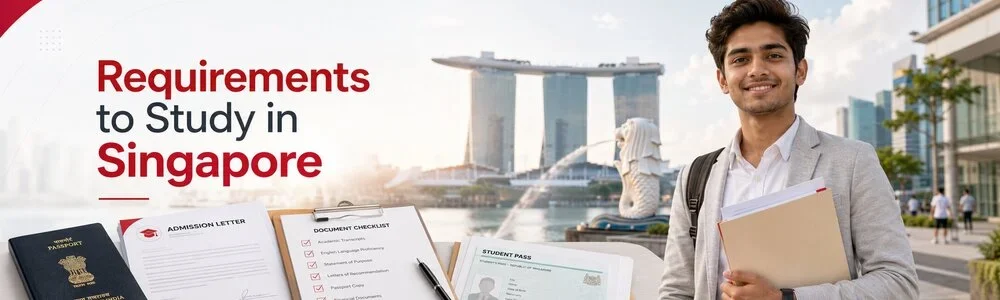
If you and your family are weighing a move to study in Singapore, the requirements to study in Singapore for Indian students come down to four things: your marks, your English proof, your money, and your Student’s Pass. The bar is genuinely high. For the 2026 intake, NTU asks Indian Standard 12 applicants for at least 90% in all subjects including English, per NTU’s India Standard 12 admissions page, which tells you how seriously Singapore weighs your board results. This guide covers undergraduate, master’s and private-diploma routes, with verified 2026 figures, so the family conversation gets easier.
Who this guide is for: Class 12 students applying for a bachelor’s degree, graduates moving from a bachelor’s to a master’s, and anyone weighing a private-college or polytechnic diploma route.

Written by
Senior Counsellor for the Middle East and Asian countries
Nagesh Danagalla helps Indian students with university selection, admissions, and student visas for Middle East and Asian destinations at AOEC India. A B.Tech and M.Tech graduate of JNTU Hyderabad, he brings destination-specific expertise in admissions and visa documentation.
5 Years, 320 students counselled
Reviewed by
Managing Director
Mr. Kongara Sridhar, Director of AOEC India, has over 12 years of experience in overseas education consulting, admissions, and student visa guidance.
Over 12 years Experience

Key Takeaways

  • Four buckets decide your application: academic marks, English proof, proof of funds, and the Student’s Pass visa.
  • NTU and SMU both ask for at least 90% in five subjects including English; NUS wants a good pass in five subjects; SUTD reviews holistically.
  • English tests are university-specific, not visa-specific: ICA never asks for IELTS, and while some universities waive a test for English-medium students, others such as SMU require one accepted standardised test (SAT, ACT, IELTS, TOEFL, C1 Advanced, PTE Academic or AST) for international qualifications.
  • A master’s needs a good Bachelor’s degree; some fields prefer GRE or GMAT, and PG English scores run higher than undergraduate ones.
  • ICA sets no universal proof-of-funds figure; about 12 months of tuition plus living costs is a planning benchmark, not an ICA rule.
  • For IHLs, ICA usually processes a Student’s Pass within one week, or two weeks if a visa is required; PEI timelines can differ. The pass is applied for through SOLAR and issued digitally only since 27 February 2023.
  • A private college must hold EduTrust certification, or ICA will not issue a Student’s Pass for its course.

Quick requirements checklist

  • Academics: Class 12 marks against each university’s cut-off (UG), or a good Bachelor’s degree (PG).
  • English / MOI: a test only where your university needs one – some waive it for English-medium students, while SMU requires one accepted standardised test (SAT, ACT, IELTS, TOEFL, C1 Advanced, PTE Academic or AST) for international qualifications.
  • Documents: transcripts, passport, recent photo, financial-support details, plus SOP and LORs for a master’s.
  • Funds: evidence covering roughly a year of tuition plus living costs (a planning benchmark).
  • Student’s Pass: a full-time offer at an approved institution, then a SOLAR application.
  • EduTrust: mandatory if you pick a private college.
  • Work rules: up to 16 hours a week in term, for students at listed eligible institutions.

What are the requirements to study in Singapore for Indian students?

The requirements to study in Singapore for Indian students separate into two layers: university admission requirements and immigration requirements. A foreigner accepted as a full-time matriculated or registered student applies for a Student's Pass online through SOLAR (ICA, Becoming a Student's Pass Holder - Institute of Higher Learning, 2026), making full-time admission the trigger for every immigration step.

Most families blur two different things into one “requirements” list. The university decides whether to admit you on academics, English and documents. Singapore’s Immigration & Checkpoints Authority (ICA) then decides, separately, whether to grant the visa. Keeping the two apart is the single biggest clarity win, so here they are side by side.

University admission requirementsICA Student’s Pass requirements
Class 12 marks (UG) or a good Bachelor’s degree (PG)Acceptance into an approved full-time course
English proof or standardised test, depending on university rulesFinancial-support, personal and address details
Transcripts, certificates, SOP and LORs as applicableEduTrust certification, for private colleges
Application fee and any portfolio or testMedical Examination Report at completion

Here’s the honest part: these study in Singapore requirements are sequential. Your marks decide your offer. Your offer triggers the Student’s Pass. Your funds support that application. Miss one and the next stalls. The cards below are the four buckets you and your parents tick off together.

Academic qualifications
 
Class 12 results for a bachelor’s, or a good Bachelor’s degree for a master’s, scored against each programme’s published bar.
English proficiency
 
A test only where the university needs one: many waive it for English-medium students, but SMU requires one accepted standardised test for international qualifications.
Proof of funds
 
Evidence your family can cover roughly a year of tuition and living costs, via bank statements or a loan sanction.
Student’s Pass
 
The student visa, applied for through ICA’s SOLAR system once you accept a full-time offer.

What academic qualifications do you need after Class 12?

Undergraduate academic eligibility is set per university against Class 12 results. The National University of Singapore requires a good pass in five subjects including English for Indian Standard 12 applicants, with standardised tests not required (NUS, Indian Standard 12 (Central and ISC Boards), 2026), confirming that board marks, not entrance exams, anchor the decision.

Let’s translate this into the numbers your family needs. The academic requirements for Singapore universities are not uniform, so a mark that clears one university may fall short at another. For the 2026 intake, NTU’s bar is at least 90% in all subjects including English, excluding optional languages and technical subjects like Home Science or Fashion Design. As of 2026, SMU sets a similar bar of at least 90% for five subjects including English. As of 2026, SUTD applies no prescribed minimum score, reviewing each application comprehensively on academic and non-academic achievements.

UniversityClass 12 cut-off (Indian boards)Standardised tests
NUSGood pass in five subjects including EnglishNot required for Indian Standard 12
NTUAt least 90% in all subjects including EnglishSAT or equivalent accepted
SMUAt least 90% for five subjects including EnglishAccepted standardised test required (any one): SAT, ACT, IELTS, TOEFL, C1 Advanced, PTE Academic or AST
SUTDNo prescribed minimum (holistic review)Portfolio and achievements weighed

One timing catch on eligibility to study in Singapore: as of 2026, NUS treats Indian Standard 12 applicants still sitting their board exam as not eligible for Dentistry, Law, Medicine or Nursing. If your child is eyeing those professional courses, that rule matters. Our guide to studying in Singapore after 12th maps each Class 12 stream to the routes open to it.

What are the requirements for a master’s after your bachelor’s?

Master's admission in Singapore rests on a strong undergraduate degree. NUS Graduate School states that an applicant must generally have at least a good Bachelor's degree, equivalent to a good Honours degree of NUS, in the appropriate discipline (NUS Graduate School, Graduate Admissions FAQ, 2026), so your bachelor's class and relevance carry the application.

Moving from a bachelor’s to a master’s in Singapore? The headline requirement is a good Bachelor degree in a relevant field (a degree of upper-second or honours standard, in plain terms). As of 2026, NTU’s coursework admission guide asks for at least a good Bachelor degree too. Beyond the degree, three things decide your master’s application: aptitude tests, English, and documents.

On aptitude tests, as of 2026, NUS Graduate School advises that applicants in engineering, computer science, medicine and science should preferably have good GRE scores, while Business applicants should have GRE or GMAT scores. So a GRE or GMAT is field-specific, not universal. Check your faculty’s page before booking a slot, because an unnecessary test wastes both money and weeks.

On English at master’s level, the scores sit higher than undergraduate ones, and they too are conditional. As of 2026, NTU’s MSc admissions set a minimum TOEFL iBT 100 or IELTS 6.5, with test dates within two years of your application. As of 2026, NUS asks for a good TOEFL or IELTS score only where your native tongue or your bachelor’s medium of instruction was not English; it publishes no single central numeric minimum, since each faculty sets its own.

On documents, as of 2026, NTU’s coursework guide lists your passport or NRIC (national identity card), one recent passport-sized colour photograph, and your Degree Certification and Official Transcripts for the bachelor’s and any master’s. Add a Statement of Purpose (SOP) and Letters of Recommendation (LORs) as standard application items, and you have a complete master’s file.

Which English-language test scores do you actually need?

English-test scores apply conditionally, not universally, and the band varies by university. For tests taken before 21 January 2026, Singapore Management University accepts IELTS 7.0 (reading 7.0, writing 6.5), TOEFL iBT 93, PTE Academic 66, or C1 Advanced 185 (SMU, International and Other Qualifications, 2026), so each institution publishes its own threshold.

Here’s the key distinction: English tests are university-specific, not visa-specific. ICA does not require IELTS for the Student’s Pass. Some universities waive an English test when English was your medium of instruction, while others, such as SMU for international qualifications, require one accepted standardised test score, namely SAT, ACT, IELTS, TOEFL, C1 Advanced, PTE Academic or AST. If you do need a score, the band depends on where you apply. For tests taken before 2026, NTU accepts a minimum IELTS Overall 6, TOEFL iBT 90 (Speaking 25), PTE Academic 55, or SAT 1250. SMU sits noticeably higher on the IELTS scale, which is the whole reason to check each university’s IELTS requirements for Singapore universities before booking a slot.

UniversityIELTSTOEFL iBTPTE AcademicOther
NTUOverall 690 (Speaking 25)55SAT 1250
SMU7.0 (R7.0 / W6.5)93 (R22 / W22)66C1 Advanced 185

Read the score table the right way: these bands apply to applicants who must submit an English test. Some universities waive it when English was your medium of instruction; others, like SMU, still require one accepted standardised test (which can be the SAT or ACT instead of IELTS) for international qualifications. Confirm your university's own rule before you treat any number here as a blanket requirement.

Aiming for that 7.0 band at SMU if you do need it? Focus your prep on the reading and writing sub-scores, which are where Indian students most often trip on the IELTS.

Can Indian students study in Singapore without IELTS?

Indian students can study in Singapore without IELTS when English was their medium of instruction. As of 2026, Nanyang Technological University states that if English is your medium of study, taking any English proficiency test will not enhance your chances of admission (NTU, India Standard 12, 2026), so an English-medium school record can substitute for the test.

Yes, and most Indian families don’t realise it until late in the process. An English-medium education can stand in for the IELTS, which quietly removes one of the most stressful boxes on the checklist. For students whose schooling was already in English, NTU is explicit that an extra test adds nothing. So here’s how to put that rule to work.

This is the Medium of Instruction (MOI) waiver, an English-language exemption for students whose schooling was in English. For Indian families, the practical question is whether your board qualifies. In our experience counselling students, the answer is usually yes when the schooling was genuinely English-medium. One caveat: a few universities, such as SMU, still require an accepted standardised test for international qualifications, though that can be the SAT or ACT rather than IELTS, so studying in Singapore without IELTS remains achievable there.

Which Indian students usually qualify for the IELTS waiver:

  • CBSE students with English as the medium of instruction across Class 11 and 12.
  • ISC / CISCE students, where English-medium delivery is standard.
  • English-medium state-board students, provided the school confirms the medium in writing.

How do you use it? Ask your school for a Medium of Instruction letter on its letterhead, signed by the principal, stating that English was the language of instruction and examination for your final years. Submit it where the application asks for English proof. A Medium of Instruction certificate that names English as the language of both instruction and examination is the wording admissions teams expect.

Public university, polytechnic or private college?

Three routes admit Indian students, and EduTrust decides whether the private route is even open. As of 2026, ICA confirms that only EduTrust-certified Private Education Institutions, registered with SkillsFuture Singapore, can offer placements to foreign students (ICA, Becoming a Student's Pass Holder - Private Education Institution, 2026), making certification a hard immigration gate.

Which route fits you? Three exist. Public Institutes of Higher Learning (IHLs), Singapore’s autonomous public universities, take you on board marks. Polytechnics offer diplomas with a more applied focus. Private Education Institutions (PEIs), the private colleges, run shorter, often cheaper pathways, frequently with partner-university degrees.

The polytechnic route has its own door. As of 2026, Ngee Ann Polytechnic admits international qualification holders through the Direct Admissions Exercise (DAE), the admissions track for foreign-qualification applicants, and you may be shortlisted to sit the polytechnic’s entrance test if you meet the minimum entry requirements of your qualification.

Now the centrepiece. EduTrust is a quality-assurance scheme administered by SkillsFuture Singapore (SSG), the national skills agency, for private colleges. Treat it as a hard gate, not a marketing badge: a PEI without it cannot sponsor your pass or offer you a place, however polished its brochure. That is exactly the trap families fall into.

TypeExamplesEntry routeEduTrust required?Student’s Pass processing
Public IHLsNUS, NTU, SMU, SUTDClass 12 marks via direct applicationNo (public universities, not PEIs)Within 1 week (2 weeks if a visa is needed)
PolytechnicsNgee Ann, othersDirect Admissions Exercise (entrance test possible)NoWithin 1 week (2 weeks if a visa is needed)
Private Education InstitutionsSIM Global Education, Kaplan, PSB Academy, JCU Singapore, MDIS, RafflesDirect application to the collegeYes – mandatoryWithin 1 month (2 weeks if EduTrust-accredited)

As of 2026, ICA processes a new PEI Student’s Pass application within one month, or within two weeks for an EduTrust-accredited PEI. So certification doesn’t just unlock the place; it speeds the visa. If you’re considering SIM Global Education, Kaplan, PSB Academy, JCU Singapore, MDIS or Raffles, confirm EduTrust status before you pay a deposit. We’ve seen students hold an offer from a college that couldn’t sponsor their pass, and that heartbreak is avoidable.

How much money do you need to show as proof of funds?

Singapore prescribes no universal proof-of-funds figure for a student visa. Funding must cover tuition plus living costs, and for the AY2026 cohort, NTU's non-subsidised international tuition runs SGD 36,350 to 40,600 per year (NTU, Tuition Fees - Accepted Programme Offer in 2026, 2026), so funds should realistically span at least one academic year.

Let’s clear up a myth, because it costs families real worry. Aggregator blogs quote a fixed “SGD 25,000 to 35,000” proof-of-funds number. ICA prescribes no such figure. What it requires is acceptance into an approved full-time course and, for PEIs, financial-support information, not a single headline amount. The “about 12 months of tuition plus living costs” guidance is a planning benchmark we use with families, not an ICA rule. The cost of studying in Singapore for Indian students starts with the tuition band below.

S$36,350-40,600

NTU annual international tuition (≈ ₹26.5L-29.6L) NTU, 2026

S$6,000

NUS indicative living cost/yr, excl. accommodation (≈ ₹4.38L) NUS, 2026

S$4,000-10,290

NUS on-campus accommodation/yr (≈ ₹2.92L-7.50L) NUS, 2026

For the AY2026 cohort, NTU charges SGD 36,350 to 40,600 (approx. INR 26.5L-29.6L) per year for non-subsidised international students, fixed at the 2026 rate for the whole degree.

Living costs sit on top of that. As of 2026, NUS publishes an indicative annual estimate of SGD 6,000 (approx. INR 4.38L) excluding accommodation, broken down as meals SGD 2,600, personal expenses SGD 2,200, transport SGD 800 and books SGD 400, with on-campus accommodation of SGD 4,000 to 10,290 (approx. INR 2.92L-7.50L). Treat that as an NUS estimate, not an ICA financial-support requirement.

Stack those into a first-year budget so the family sees the whole picture at once.

First-year cost (NTU tuition + NUS living estimate)SGDApprox. INR
Annual tuition (NTU international)36,350 – 40,60026.5L – 29.6L
Living costs, excl. accommodation (NUS estimate)6,0004.38L
On-campus accommodation (NUS estimate)4,000 – 10,2902.92L – 7.50L
One-off Student’s Pass feessee the Student’s Pass section
Indicative first-year total46,350 – 56,89033.8L – 41.5L

On the document side, Indian banks know this drill. You’ll typically prepare six months of bank statements, a bank letter confirming balances, and an education-loan sanction letter if you’re financing through HDFC Credila, Avanse or a public-sector bank. The loan sanction is what most institutions treat as the cleanest proof, so compare lender turnaround early; public-sector banks and NBFC education-loan providers differ most on how fast they sanction.

The Student’s Pass: documents and how to apply

The Student's Pass is the immigration pass for full-time study, applied for through ICA's Student's Pass On-Line Application and Registration system. SOLAR was introduced to let foreign students apply for the pass online (ICA, New SOLAR System to Facilitate Foreigners to Study in Singapore, 2003), so the core application is processed digitally from the start.

Let’s walk the Student’s Pass requirements in order, because the sequence trips people up. Knowing how to apply for a Student’s Pass before you arrive saves weeks, and our full guide to the Singapore student visa walks through the formalities stage.

Who needs a Student’s Pass?

Any Indian student accepted as a full-time matriculated or registered student needs one. As of 2026, ICA confirms part-time, evening and weekend courses do not qualify, so the pass and your full-time offer are linked.

Which documents does ICA ask for?

Good news: ICA’s live checklist is short and specific. As of 2026, ICA’s Institute of Higher Learning page lists the supporting documents below, and the process runs as the SOLAR online application followed by completion of formalities at the ICA Services Centre.

Student’s Pass document checklist (IHL)

  • The Registration Acknowledgement Letter (the school’s confirmation of your admission) from the institution you plan to attend.
  • Your travel-document biodata page, and your birth certificate if applicable.
  • A recent passport-sized digital colour photograph taken within the last three months.
  • Your financial-support, personal and address details.
  • The Medical Examination Report, submitted at completion of formalities if required.
  • Timing: apply through ICA’s e-Service at least two months and not more than three months before your course starts.

How do you apply through SOLAR, and how long does it take?

  1. Your institution registers your admission in SOLAR and gives you a reference number.
  2. You log in, complete the student’s section of the application, and upload your documents.
  3. ICA reviews and, if approved, issues an In-Principle Approval (IPA), the letter that lets you enter Singapore.
  4. After arrival, you bring the documents listed in your IPA letter to the ICA Services Centre, acknowledge the Terms and Conditions, complete the Medical Examination Report if required, and collect the digital pass.

As of 2026, for an Institute of Higher Learning (IHL) application, ICA processes a Student’s Pass within one week, and within two weeks if a visa is required, excluding the date of submission; private-college (PEI) timelines can differ. Since 27 February 2023, ICA issues the pass in digital form only, so there’s no physical card to lose.

What do the Student’s Pass fees come to?

Three distinct ICA charges apply, and families often merge them by mistake. As of 2026, the non-refundable processing fee is SGD 45 (approx. INR 3,281) per application. As of 2026, an issuance fee of SGD 60 (approx. INR 4,375) is payable on collection. And as of 2026, a Multiple-Journey Visa (a re-entry visa for repeated trips home) costs SGD 30 (approx. INR 2,188) where applicable.

FeeAmount (SGD)Approx. INRWhen
Processing fee453,281On SOLAR submission
Issuance fee604,375On collection
Multiple-Journey Visa302,188Where applicable

Can you work part-time while studying in Singapore?

Eligible full-time foreign students in Singapore may take limited part-time work. The Ministry of Manpower permits a maximum of 16 hours a week during term under its work-pass exemption (MOM, Work Pass Exemption for Foreign Students, 2026), which means part-time earnings can offset some living costs but not tuition.

Can your child earn while studying? Within limits, yes. As of 2026, MOM caps term-time work at 16 hours a week, while vacation work is unrestricted for eligible students. That’s enough for pocket money and experience, not for funding the degree, so don’t let anyone sell you that story.

A real catch for private-college students: the work-pass exemption applies only to students from a defined list of eligible institutions. Public-university students are covered broadly, while PEI students sit under a more restrictive eligible-institution list. Confirm your college qualifies before you count on part-time income.

What if your Student’s Pass application is rejected?

A rejection is not the end of the road, and panicking is the worst first move. Singapore gives you a clear appeal route, so treat a rejection as a step to manage, not a verdict. Most families we counsel never reach this stage, but knowing the process keeps everyone calm.

  1. Inform your school first. Your institution coordinates appeals and often spots the gap that triggered the rejection.
  2. Submit an appeal through ICA’s enquiry form, quoting your original application reference number so it links to your case.
  3. Strengthen the weak bucket. Usually it’s the financial proof or a document mismatch, so fix that before resubmitting.
  4. Wait for ICA’s decision and keep your offer letter and start date handy in case timelines shift.

Money is the most common stumbling block, so revisit your proof of funds and loan sanction before appealing. A counsellor who has handled Singapore appeals can tell you fast whether your case is worth resubmitting or whether you should aim for the next cycle instead.

When are the intakes and application deadlines?

Most public undergraduate admissions in Singapore run annually around the July/August start. For the 2026 intake, NTU's international application period ran from 15 October 2025 to 20 January 2026, with term typically commencing in late July (NTU, International Qualifications, 2026), confirming that applications close roughly half a year before term begins.

Timing is where families lose the most ground, so let’s pin it down. Our guide to the intakes in Singapore lays out the full calendar; most public undergraduate admissions are annual, built around the July/August start, and NTU’s term commences in late July. There’s no universal January undergraduate intake to bank on, though some institutions and private providers may offer additional intakes. For the 2026 intake, NTU’s application window ran 15 October 2025 to 20 January 2026, with a SGD 25 (approx. INR 1,823) application fee for international applicants.

MilestoneTypical timing (NTU, 2026 cycle)
Application window opens15 October 2025
Application window closes20 January 2026
Application fee (international)SGD 25 (approx. INR 1,823)
Term commencesLate July 2026

Sit down with your family in September and work backwards from that January deadline. English test if needed, transcripts, MOI letter, then the application, in that order. Start the visa steps only after the offer lands.

Get in Touch

Frequently Asked Questions

There’s no single national cut-off. NTU and SMU both ask for at least 90% in five subjects including English. NUS wants a good pass in five subjects, and SUTD reviews applications holistically with no fixed minimum, so strong all-round profiles can still compete there.

No. ICA never requires IELTS for the Student’s Pass; English tests are set by universities, not the visa. NTU waives a test if English was your medium of study, so English-medium CBSE, ISC and state-board students can use a Medium of Instruction letter. But some universities, such as SMU, still require one accepted standardised test (SAT, ACT, IELTS, TOEFL, C1 Advanced, PTE Academic or AST) for international qualifications.

A good Bachelor’s degree in a relevant field. NUS expects the equivalent of a good Honours degree and prefers GRE or GMAT for some fields. NTU asks for at least a good Bachelor degree, plus TOEFL iBT 100 or IELTS 6.5 where English was not your medium, with documents and transcripts.

For IHL applications, ICA usually processes the Student’s Pass within one week, or within two weeks if a visa is required, excluding the submission date. PEI timelines can differ. Since 27 February 2023, ICA issues the pass digitally only, so there’s no physical card to collect.

Eligible full-time students at listed institutions may work up to 16 hours a week during term and full-time during vacation, under MOM’s work-pass exemption. Private-college students sit under a more restrictive eligible-institution list, so confirm your college qualifies before relying on the income.

Public universities cost more but carry strong global recognition. Private colleges offer shorter, cheaper pathways, yet they must hold EduTrust certification, or ICA won’t issue a Student’s Pass for that course. Always confirm EduTrust status before paying any private-college deposit.

How we keep this accurate: Every fee, deadline and cut-off above is drawn from primary ICA, MOM and university sources, dated and listed below. Ardent Overseas has guided Indian students on Singapore and global admissions since 2014, from our Hyderabad and Tirupati offices. See our editorial standards for how we research and verify each figure.

Sources

Official sources first, then reputable third-party.

Everything you need to study abroad, in one place.

Explore articles and guides that help you prepare with confidence, covering scholarship applications, financial planning, and tips for adapting to a new culture. We have built comprehensive resources to get you ready for your educational adventure.

Masters in Singapore for Indian Students

Masters in Singapore

Masters in Singapore for Indian Students 2026: Fees, Universities, Eligibility & ROI Last Updated on: July 7, 2026 Thinking about