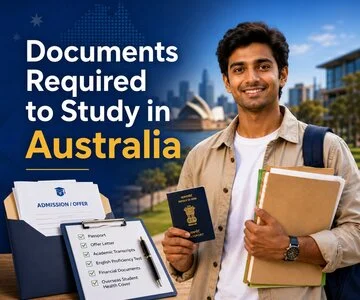
Requirements to Study in Australia for Indian Students (2026 Guide)

Requirements to Study in Australia for Indian Students

The requirements to study in Australia for Indian students in 2026 sit across four gates: your academic marks, your English score, your proof of funds, and the Genuine Student test that anchors the Subclass 500 student visa. The money gate is the one most families underestimate. Since 10 May 2024, Study Australia’s notice “Student and Temporary Graduate visa changes: 2024” set the financial requirement at AUD 29,710 (approx. INR 19.86 lakh) for a single applicant. What makes this guide different is the course-wise marks table and the side-by-side admission-versus-visa view your family rarely sees in one place. All INR conversions use the live Google-published rate captured on 2026-06-06: AUD 1 ≈ ₹66.86. Rates fluctuate intraday; figures are indicative.

Start with the quick checklist below, then drill into each gate.

Key Takeaways

  • Four gates decide eligibility: academic marks, English, funds, and the Genuine Student requirement plus a Confirmation of Enrolment.
  • A single applicant must show AUD 29,710 (approx. INR 19.86 lakh) in living-cost funds since 10 May 2024.
  • Australian universities recognise CBSE, CISCE and State Board Class 12 results for undergraduate entry.
  • The Subclass 500 visa English floor is IELTS 6.0; it is IELTS 5.0 for students taking ELICOS before their main course and IELTS 5.5 for eligible foundation or pathway programs.
  • Ministerial Direction 115 replaced MD111 on 14 November 2025 and governs 2026 offshore visa processing priority.
  • The 2026 National Planning Level is 295,000 New Overseas Student Commencements (NOSCs), 25,000 higher than 2025.
  • Student visa fees start from AUD 2,000 (approx. INR 1.34 lakh); work is capped at 48 hours per fortnight in session.

The requirements to study in Australia for Indian students cover four gates: a recognised academic record, a qualifying English result, proof of funds, and the Genuine Student requirement backed by a Confirmation of Enrolment. According to ICEF Monitor, citing Australian Government Austrade data, 139,720 Indian students were enrolled in Australia between January and September 2025. Clearing all four gates turns an offer into a granted visa.

Think of these requirements as four locks on one door. Miss any single gate and the Subclass 500 student visa stalls, no matter how strong the rest of your file looks. Your eligibility to study in Australia is not one test; it’s four that must all pass together. ICEF Monitor reports that India is the second-largest source country, with enrolments up about 4 percent year on year, so competition for clean files is real and rising. Where do you stand on each gate right now?

One sequencing rule trips up most families. As of 2026, Study Australia’s “Student visa (subclass 500)” page confirms you must hold a Confirmation of Enrolment (CoE) from a provider before the visa can be granted. So the visa gate cannot even open until your marks, English and funds are sorted. You can read the full picture on our Study in Australia hub, but here’s the at-a-glance version.

GateWhat it checksThe bar in short
Academic recordRecognised Class 12 or Bachelor’s marksCourse-specific; set by a CRICOS-registered provider
English proficiencyIELTS, PTE or TOEFL resultClears both the university band and the visa floor
Financial capacityLiving-cost funds plus tuition and travelAUD 29,710 (approx. INR 19.86 lakh), single applicant
Genuine Student + CoEStudy intent and enrolment proofGS response plus a Confirmation of Enrolment

What are the academic requirements after 12th and for a Bachelor’s?

Academic requirements for Australian universities map your Indian qualification onto the Australian Qualifications Framework. For 2026 entry, the University of Sydney's recognised qualifications list confirms the All India Senior School Certificate (CBSE), Indian School Certificate (CISCE) and State Board Higher Secondary Certificate are accepted for undergraduate entry. Recognition means your marks are assessed directly, without a mandatory bridging year for most courses.

Many families assume a single nationwide cut-off mark exists. It doesn’t. Each provider sets its own course bar, and the academic requirements for Australian universities are read against the AQF (Australian Qualifications Framework, the national ladder that ranks every certificate, diploma and degree). For 2026 entry, the University of Sydney recognises CBSE, CISCE and State Board Higher Secondary results, so a strong Class 12 record can take you straight into a Bachelor’s program.

Study in Australia after 12th

If you plan to study in Australia after 12th, your board matters less than your subject marks and the English component. Competitive Bachelor’s programs read your best four or five graded subjects, not just the aggregate. A CBSE student and a State HSC student with the same effective percentage are treated on comparable terms for most undergraduate courses.

Postgraduate entry on a Bachelor’s degree

For a Master’s, providers assess your Indian Bachelor’s against the relevant AQF level and weigh your final-year and major-subject results. Strong project or dissertation work helps marginal cases, and some specialisations expect relevant work experience.

  • Undergraduate: recognised Class 12 board result with subject prerequisites met.
  • Postgraduate: a relevant Bachelor’s degree assessed at the matching AQF level.
  • Pathway option: a foundation or diploma route where your marks fall just short.

What minimum percentage do you need by course?

No universal minimum percentage governs Australian admission; each university sets its own course cut-off. For 2026 entry, RMIT University's India academic entry requirements show Foundation entry from a 60 percent average and Bachelor degrees from a 65 percent minimum average, rising toward 70 to 90 percent for more selective programs. Treat published bands as indicative starting points, not fixed national rules.

Parents often ask for “the percentage” as if one number exists. It doesn’t. The honest answer is a range that shifts by university and program. RMIT University, averaging across graded academic subjects, sets the minimum percentage for Australia entry on a sliding scale where a 65 percent average maps to a 65 percent Australian equivalent, and a 90 percent average maps to 90 percent. The table below is indicative only, since each university and program sets its own cut-off.

Study level / pathwayIndicative India averageNotes
Foundation studiesFrom 60% averageBridges Class 12 to a Bachelor’s; indicative, varies by provider.
Diploma / pathwayAround 60%Can give credit toward year one of a degree.
Bachelor’s (standard)From 65% minimum averageAveraged across graded academic subjects.
Bachelor’s (selective)70-90% averageCompetitive and high-demand programs sit at the top end.

Selective fields raise the bar further. Medicine, law and some business programs usually sit at the high end of that range and may add an entrance test such as the UCAT, LSAT or GMAT. Because these cut-offs differ by course and move each intake, we map your exact marks to live program requirements rather than quoting a generic number. Treat any percentage you read online, including ours, as a starting point and confirm it against the specific program.

What English score do you need (IELTS, PTE, TOEFL and exemptions)?

The English language requirements for Australia operate at two levels: a university admission band and a separate visa floor. For 2026 entry, the University of Sydney's English language requirements set a standard IELTS overall 6.5 with no band below 6.0, the typical Group of Eight admission bar. Both this band and the lower Subclass 500 visa floor must be cleared.

Strong students get caught out here, because your university offer and your visa test two different English bars. The admission band is what your university wants; the visa sets a separate, lower floor. From 23 March 2024, Study Australia confirms new English language requirements for Australia apply to all student visa applications. Since 23 March 2024, according to IELTS Australia, the Subclass 500 visa floor is IELTS 6.0 overall, dropping to 5.0 for students taking ELICOS (English Language Intensive Courses for Overseas Students) before their main course, and 5.5 for an eligible foundation or pathway program.

PurposeTypical IELTSNote
University offer (typical Group of Eight)6.5 overall, no band below 6.0University of Sydney standard; some courses set higher.
Subclass 500 visa floor6.0 overallVisa-level minimum, distinct from admission.
Visa floor with ELICOS before main course5.0 overallEnglish study completed before the main course.
Visa floor for foundation / pathway5.5 overallApplies to a university foundation or pathway program.

So the IELTS score for Australia student visa purposes is a floor, not a finish line. Aim for the higher admission band and the visa takes care of itself. PTE Academic and TOEFL iBT are accepted alternatives at most providers, and some accept a Medium of Instruction letter or other exemption where your prior study was in English. Confirm which exemption route applies to you before assuming a waiver, because the visa rules are stricter than many admission pages suggest.

What does the Subclass 500 student visa require?

The Subclass 500 student visa is the single visa Indian students use to study a full-time course in Australia. As of 2026, Study Australia's Student visa (subclass 500) page confirms a Confirmation of Enrolment from a CRICOS-registered provider is required before grant, and Overseas Student Health Cover must be held for the whole stay. The visa tests integrity, funds and enrolment together.

What your university wants and what the visa wants are two separate lists, and blurring them is what sinks otherwise strong files. Your offer is an academic decision; the Australian student visa requirements are an integrity and capacity decision made by the Department of Home Affairs. As of 2026, Study Australia confirms OSHC (Overseas Student Health Cover, your mandatory health insurance) must be maintained for the whole period of stay under visa condition 8501. Reading the two columns side by side is the fastest way to spot your weak link.

What your university wantsWhat the Subclass 500 visa wants
Recognised academic marks for the courseA Confirmation of Enrolment (CoE) from a CRICOS provider
The admission English band (often IELTS 6.5)The visa English floor (from IELTS 6.0)
Course prerequisites and documentsGenuine Student response to targeted questions
Tuition deposit to issue the CoEProof of funds plus OSHC and the visa fee

From 1 July 2025, Study Australia confirms student visa fees start from AUD 2,000 (approx. INR 1.34 lakh) per application. You lodge through ImmiAccount, the Department of Home Affairs online portal. For the full step-by-step visa walkthrough, including conditions 8105, 8202 and 8501, see our dedicated guide to the Australia student visa for Indian students.

What does the Genuine Student requirement check?

The Genuine Student requirement is the integrity test the Department of Home Affairs uses to confirm an applicant genuinely intends to study. From 23 March 2024, Study Australia's Student and Temporary Graduate visa changes: 2024 confirm the Genuine Student (GS) requirement replaced the Genuine Temporary Entrant (GTE) requirement, using a list of targeted questions instead of one open essay.

If one requirement quietly decides more visas than any other, it’s this one. The GS requirement asks you to show, in your own words, why this course, this provider and this country make sense for your career. From 23 March 2024, the Genuine Student requirement replaced the GTE (Genuine Temporary Entrant) test, and the GS statement now answers a fixed set of targeted questions rather than one free-form response. What does an officer actually weigh?

In the files we prepare from Tirupati, the weakest GS responses simply repeat the brochure back to the officer. The strong ones connect your Class 12 stream or Bachelor’s specialisation to a specific Australian course outcome and a clear plan back home. Parents reading this: a vague “better future” line is exactly what triggers a closer look, so your financial capacity evidence and your study logic must line up.

  • Your circumstances: ties to India, family and finances explained plainly.
  • Why this course: how it follows from your past study and goals.
  • Why Australia: a reasoned choice over options at home or elsewhere.
  • Post-study intent: what you plan to do after the course ends.

How much money do you need in 2026 for a student, partner and children?

The financial requirements for Australia student visa applicants centre on a single living-cost figure plus add-ons for family. As of 10 May 2024, ICEF Monitor, reporting Department of Home Affairs figures, put the requirement for a single applicant at AUD 29,710 (approx. INR 19.86 lakh), a 21 percent rise on the old AUD 24,505. This sum sits on top of tuition and travel.

Money is the gate that decides most family budget conversations. Since 10 May 2024, Study Australia sets the proof of funds for Australia student visa applications at AUD 29,710 (approx. INR 19.86 lakh) for a single primary applicant, on an annual basis. Bringing a partner or children raises the bar, because the Department of Home Affairs adds set living-cost amounts for each dependant. When you and your family sit down to plan, this is the full picture in INR.

Cost componentAUDINR (approx.)Notes
Single applicant living fundsAUD 29,710INR 19.86 lakhAnnual proof, primary applicant.
Partner add-on+AUD 10,394+INR 6.95 lakhDepartment of Home Affairs financial capacity figure.
Each dependent child+AUD 4,449+INR 2.97 lakhPer accompanying child, on top of the single amount.
School-age child school costs+AUD 13,502+INR 9.03 lakhAnnual schooling per school-age child, plus return travel.
Visa application feefrom AUD 2,000from INR 1.34 lakhOne-off per application, from 1 July 2025.

A note on the family figures: the partner, child and school-cost amounts above are the Department of Home Affairs figures that applied from 10 May 2024. The Department revises them from time to time, so we re-verify the exact numbers against your file before you lodge.

In the funds files we lodge from Hyderabad, the question that stalls a case is almost never the headline amount; it’s where a sudden large deposit came from. We tell families to season their savings early and keep the paper trail clean.

The proof of funds for Australia student visa purposes must also look genuine: stable savings, a clean education-loan sanction from a lender such as HDFC Credila, Avanse or SBI, and a clear source for every large deposit. Tuition itself varies widely by course, so we won’t quote a single headline number that could mislead your planning. For the full living-cost and tuition breakdown, see our companion guide on the cost of studying in Australia for Indian students.

What documents do you need for an Australia student visa?

The documents required for Australia student visa applications are organised around the Subclass 500 lodgement in ImmiAccount. As of 2026, Study Australia's Overseas Student Health Cover (OSHC) page confirms OSHC is mandatory for the entire duration of study, with accompanying dependents covered too. A complete, consistent file is what separates a clean grant from a request for more information.

A refusal is rarely about one missing form; it’s usually about a file that contradicts itself. Every document must tell the same story as your Genuine Student response, so one mismatched date or name can invite delay. Here is the core set most Indian applicants assemble before lodging in ImmiAccount.

  • Confirmation of Enrolment (CoE): from a CRICOS-registered provider.
  • Passport and academic records: Class 12 or degree transcripts and marksheets.
  • English result: IELTS, PTE or TOEFL meeting the visa floor.
  • Financial capacity evidence: savings, loan sanction, sponsor letters.
  • OSHC policy: health cover for your full course duration.
  • Genuine Student response: answering all targeted questions.

This is a summary, not the full checklist. For the exhaustive document list, formatting tips and common rejection triggers, follow our detailed guide to the documents required to study in Australia for Indian students.
Which 2026 rule changes must Indian students know?

Australia rewrote several student visa rules between 2024 and 2026, and the headline 2026 change is a new processing direction. On 14 November 2025, Study Australia's Ministerial Direction 115 came into effect and replaced MD111; offshore applications lodged before 14 November 2025 stay under MD111, and those on or after fall under MD115. The direction affects processing priority for offshore applications, but actual timing still depends on provider status, application completeness and individual checks.

Most guides list requirements as if they were carved in stone. The reality is that Indian applicants relying on older blog posts get tripped up. Ministerial Direction 115 (MD115) is the rule that leads your 2026 file: it replaced MD111 on 14 November 2025 and sets your processing priority. For 2026, Study Australia confirms the National Planning Level is set at 295,000 New Overseas Student Commencements (NOSCs), 25,000 places higher than 2025, with three processing priorities based on a provider’s progress against its NOSC allocation. Which university you choose can affect how fast your visa moves.

ChangeEffective dateWhat it means for you
Ministerial Direction 11514 November 2025Replaces MD111; governs 2026 offshore processing priority.
2026 National Planning Level2026 cycle295,000 NOSCs, 25,000 higher than 2025.
Ministerial Direction 11119 December 2024Now applies only to offshore lodgements before 14 Nov 2025.
Funds raised to AUD 29,71010 May 2024Show AUD 29,710 (approx. INR 19.86 lakh) living funds, single applicant.
GS replaced GTE23 March 2024Answer fixed targeted questions, not one open essay.
New English requirements23 March 2024Higher English bars apply to all new student visa applications.
Visa fee from AUD 2,0001 July 2025Budget from AUD 2,000 (approx. INR 1.34 lakh) per application.
48 hours/fortnight work capsince 1 July 2023Plan finances without assuming unlimited term-time work.

Two points reshape strategy. From 19 December 2024, Study Australia’s new prioritisation system introduced provider-level priority under MD111, which now only governs offshore applications lodged before 14 November 2025. Since 1 July 2023, Study Australia confirms work is limited to 48 hours per fortnight during session under visa condition 8105, with unlimited hours only on scheduled breaks. If you’re the parent funding this, that cap is the figure to plan around, because it limits the part-time income your child can rely on. Visa condition 8202 (maintaining enrolment) and condition 8501 (keeping OSHC active) round out the live obligations.

How do you apply for an Australia student visa, step by step?

The application process moves from course offer to CoE to visa lodgement, timed around Australia's two main intakes. For the 2026 cycle, Study Australia's mid-year entry guidance confirms the two main intakes are Semester 1 (February) and Semester 2 / mid-year (July), with many providers offering mid-year entry and dates varying by provider. Sequencing the steps in order keeps your file consistent.

The process is logical once you see it as a chain, where each link unlocks the next. We follow a seven-step sequence with families, and getting the order right is what keeps your Genuine Student story consistent across documents.

  1. Shortlist a CRICOS-registered course that fits your marks, budget and goals.
  2. Meet the academic and English bars for that specific program.
  3. Accept the offer and pay the deposit to receive your Confirmation of Enrolment.
  4. Prepare your Genuine Student response to the targeted questions.
  5. Prove your funds and buy OSHC covering your full stay.
  6. Lodge the Subclass 500 in ImmiAccount with every document attached.
  7. Complete health and character checks as requested by the department.

This is a condensed seven-step view. The full official process adds more checkpoints, including the letter of offer, the Confirmation of Enrolment, English proof, your Genuine Student response, funds, OSHC, health and character checks, ImmiAccount lodgement and travel. For the detailed walkthrough, including offer timing, deposit logistics and deadline planning, see our full guide to the Australia admission process for Indian students.

Get in Touch

Frequently Asked Questions

Sometimes. Some providers accept your Class 12 English marks, PTE Academic or TOEFL iBT, or a Medium of Instruction letter. But the Subclass 500 visa still expects a recognised English result unless a specific exemption applies, so confirm your exact route before assuming a waiver.

Since 10 May 2024, a single applicant must show AUD 29,710 (approx. INR 19.86 lakh) in living-cost funds, plus tuition and travel, on top of the visa fee. A partner adds about AUD 10,394 and each child about AUD 4,449.

The Genuine Student requirement replaced the Genuine Temporary Entrant test from 23 March 2024. Instead of one open statement, you now answer a fixed list of targeted questions about your study choice, ties to India and post-study plans.

According to IELTS Australia, the Subclass 500 visa floor is IELTS 6.0 overall, or 5.0 for students taking ELICOS before their main course, or 5.5 for an eligible foundation or pathway program. Your university will usually want a higher admission band.

Possibly. A parent or relative can apply for a Student Guardian visa (subclass 590) to stay with a younger student, which usually requires a Confirmation of Appropriate Accommodation and Welfare (CAAW). We confirm whether your case needs this during counselling.

Meeting the requirements to study in Australia for Indian students is less about ticking boxes and more about making every gate agree with the next. Get your marks recognised, clear both English bars, prove the AUD 29,710 cleanly, write a Genuine Student response your documents can back up, and lodge under the right Ministerial Direction. Ardent Overseas runs counselling from offices in Hyderabad and Tirupati and has guided Indian families through Australian student visa files year after year. To see how we research and verify the figures in guides like this, read more about our team on the AOEC India page.