Study in Australia for Indian Students Item #1 Item #2 Item #3 If you are an Indian student planning to
Documents Required to Study in Australia for Indian Students: 2026 Visa Checklist
- Last Updated on: October 13, 2026 by
- Sridhar Kongara
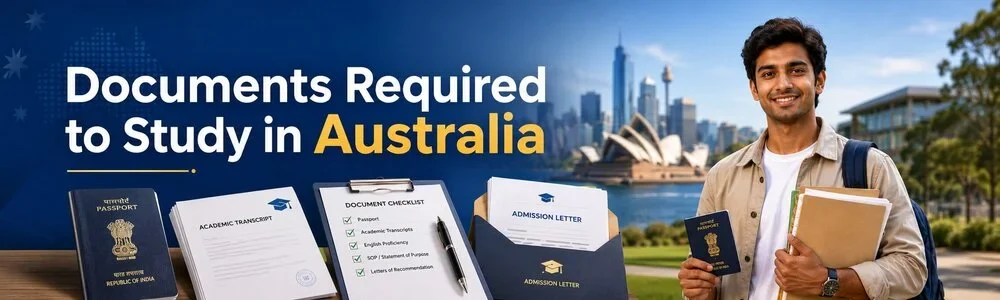
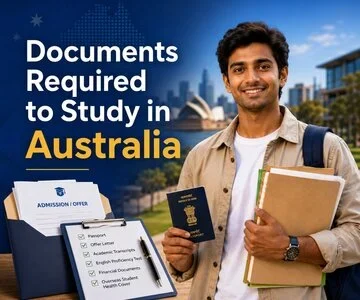
The documents required to study in Australia for Indian students are a Confirmation of Enrolment (CoE, proof of your place), passport, academic records, an English test report, funds evidence and health cover. You’ll also need Genuine Student answers (why study is your main reason for going). Police, biometrics and under-18 papers apply only to some students, and every Indian student staying 6 months or more also needs a visa medical.
In 2026, the CoE matters most: without it, Australia’s Department of Home Affairs (the immigration department) can’t accept your Subclass 500 (student visa) application at all. So accept your offer, get the CoE, and gather papers that show where your money came from. Then run the Home Affairs Document Checklist Tool before you apply for the visa. For the wider move, see our guide to study in Australia.
Key Takeaways
- As a worked example, an AUD 40,000 (approx. INR 26.90 lakh) first-year fee means showing AUD 71,710 (approx. INR 48.23 lakh) before any deposit: AUD 29,710 (approx. INR 19.98 lakh) for living costs, the fee, and AUD 2,000 (approx. INR 1.35 lakh) for travel.
- If your parents earned at least AUD 87,856 (approx. INR 59.09 lakh) in the last 12 months, their Income Tax Department documents can replace savings.
- You don’t need certified copies, because colour scans of the originals are enough.
- If you’re under 18, you’ll need consent from each parent and a care arrangement in Australia.
- From 2 October 2026, most students can no longer bring a spouse or children, and family can’t join later.
Table of Contents
Australia student visa documents checklist for Indian students
Scroll here ↓
Financial documents for an Australia student visa from India
Scroll here ↓
English test scores and Genuine Student answers for the Subclass 500
Scroll here ↓
Health exam, police certificate, biometrics and under-18 documents
Scroll here ↓
Document mistakes Indian applicants make, and when to prepare each
Scroll here ↓
Frequently Asked Questions
Scroll here ↓
Australia student visa documents checklist for Indian students
This checklist shows who issues each paper in India and the format Home Affairs wants. The Home Affairs Document Checklist Tool is updated on 31 March and 30 September each year, and sometimes in between, so run it again the week you apply.
| Document | Issued by in India | Format to prepare | Who needs it |
|---|---|---|---|
| Passport bio pages, plus a national ID card if you have one | Passport Seva / Regional Passport Office (passport) | Passport must be valid on the day you apply (no six-month rule) | Everyone |
| Letter of Offer | Your Australian university | Accept it to get your CoE; the visa form asks for the CoE | Everyone |
| Confirmation of Enrolment (CoE) | Your university, once you accept the offer and pay the deposit | Must be for a full-time course on CRICOS (the government’s list of courses open to overseas students); upload every CoE you hold (e.g. English course + degree) | Everyone |
| Class 10 and 12 marksheets | CBSE, ICSE or state board | A colour scan of each sheet | Everyone |
| Degree transcripts and certificate | University registrar | All pages saved as one file | Graduates |
| English test report | IELTS, PTE, TOEFL or Cambridge test centre | Taken in person (fully online or at-home tests not accepted) | Everyone except research degrees |
| Funds evidence | Bank, education lender or scholarship body | Statements showing how the money built up, or a loan disbursement letter | Everyone, if the checklist or Home Affairs asks |
| Sponsor relationship and ID proof | Birth certificate registrar; sponsor’s own ID | A colour scan | Only if someone else pays |
| Parents’ income tax documents | Income Tax Department | Less than 12 months old | Only on the income route |
| OSHC policy (compulsory student health insurance) | ahm, Allianz Care, Bupa, CBHS, Medibank or nib (any one of these approved companies) | Insurer name and paid cover dates, from the day you arrive (not the course start) to the end of your visa | Everyone |
| Genuine Student answers | You | Answers typed into the visa form in English, up to 150 words per question | Everyone |
| Work or gap evidence | Your employer | Work records plus a manager’s contact who can confirm them | Only if you worked or had a gap |
| Health examination | Panel clinic (a clinic in India approved by Australia to do visa medicals) | Results linked to your HAP ID (the reference number Home Affairs gives you for your medical) | Anyone staying 6+ months |
| Police clearance certificate (PCC) | Passport Seva | Valid for 12 months from issue | Only if asked |
| English translation | Any translator in India; no accreditation needed | Upload with the original; translator’s details in English | Any non-English document |
| Consent and welfare forms | Parents; your provider or a guardian | Form 1229 or a statutory declaration from each parent, a birth certificate naming your parents, plus CAAW or Form 157N | Under 18 only |
In our 2026-intake files, naming every scan by stage (offer, CoE, visa) is the habit that kept files complete. Five types of applicant need papers beyond the standard documents required to study in Australia for Indian students:
You’ll need your parents’ bank statements showing how the money built up, plus your birth certificate and their ID. Add proof of money they’ve already given you or another student-visa holder, such as a sibling. Your next step: gather a paper for every deposit.
A disbursement letter, showing your lender has actually released the money, is the best proof of a loan. Ask your lender (HDFC Credila, Avanse, SBI) early when it will release the first payment.
Each parent signs Form 1229, or a statutory declaration (a signed written statement), to consent. You also need your university’s CAAW (Confirmation of Appropriate Accommodation and Welfare) letter promising housing and care, or Form 157N naming a parent or relative aged 21+ who’ll care for you.
Home Affairs publishes no limit on gaps in your studies in India. A past visa refusal or cancellation is different: Home Affairs weighs it, and it can make you ineligible. Back each gap with proof of what you did, such as job records, course certificates or medical papers.
From 2 October 2026, most students can’t bring a spouse; PhD (not Master’s by Research) students and scholars fully funded by their home government are the main exceptions. So decide who travels before you pay the deposit.
Financial documents for an Australia student visa from India
In 2026, proof of funds for a Subclass 500 visa means showing AUD 29,710 (approx. INR 19.98 lakh) for 12 months of living costs, plus first-year course fees minus anything already paid, plus AUD 2,000 (approx. INR 1.35 lakh) for travel from India. You don't spend this money; you show it's there and where it came from.
Three kinds of money usually count: savings with a bank or other financial institution, a loan from the government or a financial institution and a scholarship. Awards open to Indian students are in our scholarships in Australia guide. Every deposit you show needs a paper trail, such as an FD maturity letter, a property sale deed or a loan letter.
What matters is where each deposit came from, and a one-day balance certificate can’t show that. Here’s what works, strongest first:
- A disbursed education loan. Proof that your lender has released the money is the best evidence for a loan; a sanction letter on its own carries less weight.
- Your parents’ income. In 2026, if your parents earned at least AUD 87,856 in the 12 months before you apply, that replaces the savings test. If both work, their combined income can count. Prove it with official Income Tax Department documents for their latest return, less than 12 months old (bank statements, salary slips and employer letters don’t count).
- Savings with a trail. Fixed deposits or salary credits work, as long as each has a paper showing where it came from.
For example, a course with an AUD 40,000 first-year fee means showing AUD 71,710. Any fee you’ve already paid, such as your deposit, comes off that total if you upload the receipt or your CoE. The AUD 40,000 is an example: your real fee is on your offer letter, and our cost of studying in Australia guide lists typical fees. On top of the funds you show, you pay the visa application charge, which starts at AUD 2,500 for the main applicant from 1 July 2026.
English test scores and Genuine Student answers for the Subclass 500
An English-medium degree from India does not replace the test. The study-based exemption needs at least 5 years of study in English in one of seven countries, such as the UK, USA or Canada, and India isn’t one. The Subclass 500 minimum is IELTS 6.0, PTE Academic 47 or TOEFL iBT 67, taken within 2 years before you apply.
These minimums apply to tests taken on or after 7 August 2025. Your university usually sets its own English score as well, which can vary by course, and you need to meet both. For example, the University of Sydney English language requirements set a standard of IELTS 6.5 overall with no band below 6.0, though some faculties and courses differ.
Scored a little under the visa minimum? You can still meet it if you take ELICOS (an English course in Australia before your degree) first:
- 10+ weeks of ELICOS, or a Foundation or eligible Pathway program: IELTS 5.5, PTE 39 or TOEFL 51.
- 20+ weeks of ELICOS: IELTS 5.0, PTE 31 or TOEFL 37.
If you book TOEFL, select “Taking TOEFL for Australia” when you register, or the score won’t count for the visa. An MOI certificate (a college letter saying you studied in English) doesn’t count for the visa either; whether a university takes one is a question for Australian university admission.
You answer the Genuine Student requirement questions inside the visa form, in English, in up to 150 words per question. If a similar course exists in India, you must explain why you’re not taking it there. Say what your Australian course teaches, or the career it opens, that a course at home can’t. Back your answers with evidence such as:
- school and university transcripts
- 12 months of employment or business records
- an income tax return or bank statements
Health exam, police certificate, biometrics and under-18 documents
Because you’ll stay 6 months or more, you’ll need a routine medical: a doctor’s exam, a chest x-ray (age 11+) and an eGFR kidney blood test (age 15+). Home Affairs asks this of everyone from a country outside its low tuberculosis (TB) risk list. India is not on that list, so the medical is standard, not a red flag.
If you’re 15 or older and training as a doctor, dentist, nurse or paramedic, you’ll also need HIV and hepatitis B and C tests. You can take the medical before applying or, after applying, complete your medical history in ImmiAccount to get the referral letter. That letter carries your HAP ID, which the panel clinic needs.
- Biometrics (fingerprints and a photo): you give them only if Home Affairs asks, and then within 14 days, before you travel.
- Criminal record: send a PCC (police clearance certificate) only if Home Affairs asks for one.
- Under 18: your care arrangement must be in place before you enter Australia. It must last until you turn 18, or until your stay ends if that comes first.
Document mistakes Indian applicants make, and when to prepare each
Four mistakes with the documents required to study in Australia for Indian students often hold up applications, and each is easy to fix:
- Name mismatch. Spell your name exactly as it appears on your passport, and declare every other name you’ve used.
- Untranslated Telugu or Hindi papers. A translator in India needs no accreditation, but must add their full name, address, phone number, and qualifications and experience, all in English.
- Expired CoE date. If your course start date has passed, upload an updated CoE with the new date.
- Missing funds proof. If the checklist asked for it and it’s missing, Home Affairs can refuse your visa without asking you first.
Our study in Australia consultants in Hyderabad check each file for these four before it is lodged.
From our counselling desk: Hyderabad students we counsel most often trip on a lump-sum deposit with no source paper, or an English test report that has expired by the day they apply. You can spot both months ahead.
Start about 10 months out: in our files, the university application takes longer than the visa. Work back from your Australia intakes target:
- 9-10 months before: shortlist universities, renew a passport near expiry and book the English test.
- 7-8 months before: sit the test, apply to universities using our Australia study requirements guide and order translations.
- 5-6 months before: accept an offer, pay the deposit, get your CoE, buy OSHC and ask your lender to disburse.
- 4-5 months before: take the health exam and apply in ImmiAccount (the Home Affairs online account); our Australia student visa guide walks through the form.
As of late September 2026, half of university-student applications were decided within 16 days, and 9 in 10 within 4 months. That’s why the plan has you applying 4-5 months ahead.
Get in Touch
Frequently Asked Questions
Is a police clearance certificate needed?
Only if Home Affairs asks. If you’re over 17, it usually wants one from each country where you’ve lived for 12 months or more in the past 10 years. For most students that means just India, through Passport Seva. A certificate is valid 12 months from issue, so wait for the request.
Do documents need to be notarised or certified?
No. A clear colour scan or photo of each original is enough, with multi-page documents saved as one file. A translator outside Australia doesn’t need accreditation either. If your name differs across papers, upload proof of the change, such as a marriage certificate, with your passport bio pages.
Can my parents' income count instead of a bank balance?
Yes, if your parents earned at least AUD 87,856 (approx. INR 59.09 lakh) in the 12 months before you apply. If both work, their combined income can count. If you’re still allowed to bring family, such as a PhD student, it’s AUD 102,500 (approx. INR 68.94 lakh). Bank statements and employer letters don’t count.
Is an SOP required for the visa?
Not for the visa. Type your Genuine Student answers into the visa form, in English, up to 150 words each; Home Affairs prefers that to a separate statement. Your university may still ask for an SOP when you apply for admission, so keep it consistent with those answers.
How long is an IELTS or PTE score valid?
Take the test within 2 years before you apply for the visa. If the checklist doesn’t ask for a score and Home Affairs requests one later, the test must still be under 2 years old on the day it decides on your visa.
Everything you need to study abroad, in one place.
Explore articles and guides that help you prepare with confidence, covering scholarship applications, financial planning, and tips for adapting to a new culture. We have built comprehensive resources to get you ready for your educational adventure.
Australia Intakes for Indian Students
Australia Intakes for Indian Students: 2027 Dates, Deadlines & Which to Choose For 2027 entry, Australian universities typically run two
Australia Student Visa for Indian Students
Australia Student Visa for Indian Students: 2026 Fee, Funds & New Rules The Australia student visa for Indian students is